Back












































 Platform Options


Your freight is traveling from Chicago to Atlanta. Along the way, it may share trailer space with shipments headed to Nashville, Birmingham, and other destinations. How do LTL carriers coordinate all that freight while keeping transportation efficient and costs manageable?
The answer is the hub-and-spoke model, a transportation strategy that connects local terminals and regional distribution hubs to move freight through an organized network. By consolidating shipments and coordinating routes, less-than-truckload (LTL) carriers can serve businesses that don’t have enough freight to fill an entire truck.
But what does the hub-and-spoke model look like in action? Let’s follow an LTL shipment from pickup to delivery and explore how this approach influences shipping costs, transit times, and freight handling.
Less-than-truckload (LTL) shipping allows multiple businesses to share space on the same truck. Instead of reserving an entire trailer, you pay to transport your freight alongside shipments from other customers.
LTL shipping is commonly used for palletized goods that are too large or heavy for conventional parcel shipping but don’t require a full truckload. Shipments often weigh approximately 150 to 15,000 pounds, although carrier requirements and service options vary.
For example, imagine three businesses shipping freight from Chicago:
Although each shipment has a different destination, all three are headed toward the same general region. This allows them to share trailer space for part of the journey before being separated and routed to their final destinations.
The hub-and-spoke model is a shipping system that uses a network of terminals to move freight. At each terminal, shipments are unloaded, sorted, and loaded onto trucks headed toward their next destinations. Some shipments may pass through several terminals and travel on different trucks before reaching their final destinations. On each leg of the journey, shipments can share trailer space with freight from other businesses traveling in the same general direction.
Think about how connecting flights work. Airlines bring passengers from different cities into major airports, where they board connecting flights to their destinations. This arrangement allows airlines to connect more cities without operating nonstop flights between every possible pair.
Hub and spoke logistics uses a similar strategy. Local trucks collect shipments and bring them to nearby terminals. From there, carriers organize freight for longer-distance transportation before sending it to facilities responsible for final delivery.
Several facilities and transportation activities work together to move shipments through an LTL network.
Carriers don’t all organize their networks the same way. Some use major regional hubs, while others rely more heavily on direct connections between local terminals. These facilities may also be called service centers.
Cross-docking is an important activity within many LTL networks. It involves transferring freight from incoming trucks to outgoing trucks with little or no long-term storage.
For example, a shipment arriving at a terminal in the evening might be unloaded, sorted, and moved to another trailer scheduled to depart later that night. Unlike a traditional warehouse, where products may remain in storage for extended periods, a cross-docking operation focuses on moving freight through the facility.
Let’s return to our Chicago furniture manufacturer. The business needs to deliver four pallets of office furniture to a customer in Atlanta. The shipment is packaged, labeled, and ready for pickup.
Here’s one possible journey through an LTL carrier’s network. The specific terminals, connections, and transportation schedule would depend on the carrier.
A local LTL driver arrives at the warehouse to collect the four pallets. The driver may have several other pickups scheduled in the area, allowing the carrier to collect freight from multiple businesses during the same route.
The shipment’s bill of lading (BOL) provides important information, including the shipper, consignee, freight description, and transportation requirements. The carrier also typically assigns a tracking identifier, commonly called a PRO number.
After completing the pickup route, the driver returns to the local terminal. Dockworkers unload the collected freight, identify where each shipment needs to go, and prepare outbound trailers based on the carrier’s routing plan.
Our four pallets are assigned to a trailer traveling toward the Southeast, alongside other freight moving through the same part of the network.
The truck departs on its scheduled linehaul route. Linehaul transportation refers to the movement of freight between terminals, typically over longer distances than local pickup and delivery routes.
Carriers coordinate these departures with other terminals and connecting routes. If freight misses an outbound departure, it may need to wait for another available movement.
That’s one reason pickup cutoffs and terminal processing times can influence delivery expectations.
Depending on the carrier’s network, the trailer may stop at a regional terminal. Workers unload the freight and sort shipments according to their next destinations. Our furniture might be placed on a trailer headed toward Atlanta, while other shipments continue toward Charlotte or Jacksonville.
This is why an LTL shipment may not take the shortest route to its destination. Carriers consider terminal connections, freight volumes, scheduled departures, and service requirements when planning routes. Sometimes, moving freight through another terminal is more efficient than sending a truck directly to its destination.
The furniture arrives at the carrier’s Atlanta-area terminal. Dockworkers organize the freight for local delivery routes and prepare it for dispatch. If the consignee requires a delivery appointment, the carrier may need to coordinate a receiving window before sending the shipment out.
A local driver transports the four pallets to the customer. The receiving party should inspect the shipment for visible damage or shortages and document any exceptions on the delivery receipt.
Once delivery is completed, the carrier records the shipment’s final status. Our furniture has reached Atlanta, even though it may have traveled on several trucks along the way.
Here’s a simplified illustration of how freight can move through a connected LTL network.
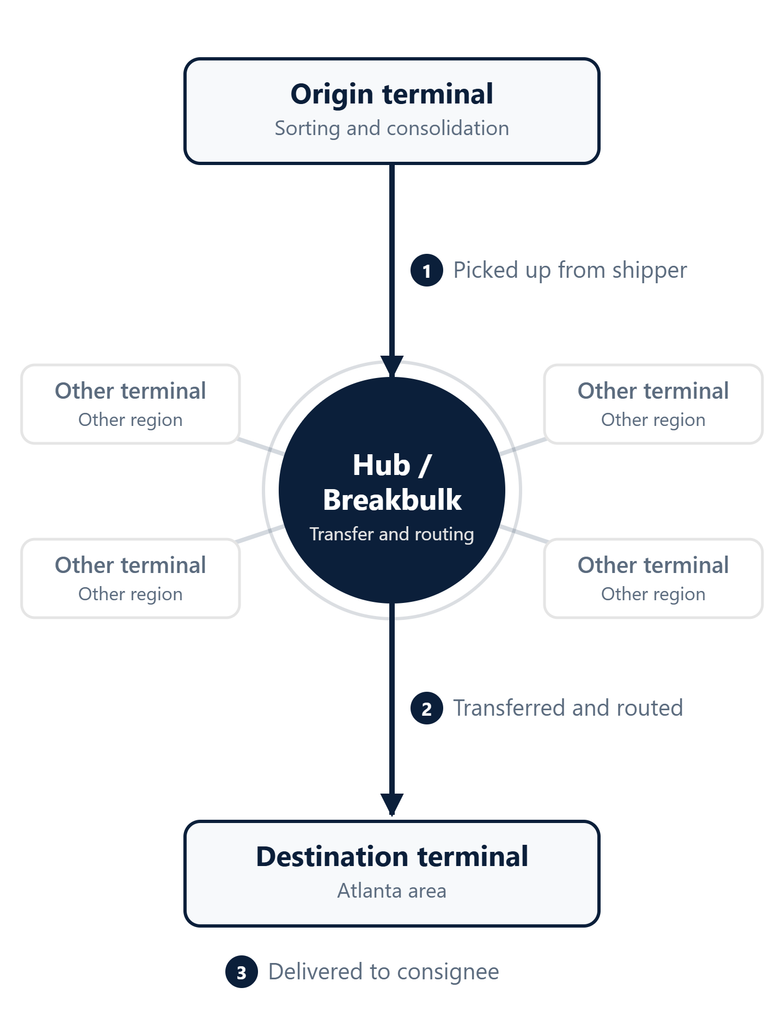
This illustration represents one possible shipment journey. Some LTL freight moves directly between origin and destination terminals without passing through a separate regional hub.
Not all freight moves through a network of terminals. With point-to-point shipping, a truck typically travels directly from the pickup location to its destination, without stopping at terminals to unload or transfer freight.
For example, a manufacturer shipping a full truckload to a distribution center may use a direct route instead of moving freight through multiple terminals.
Here’s how the two approaches compare.
Neither approach is automatically better. Some LTL carriers combine both methods, using direct terminal connections on certain routes and intermediate facilities on others.
The hub-and-spoke strategy helps carriers operate extensive transportation networks without needing direct truck routes between every possible shipping location.
For shippers, this approach offers several advantages:
These advantages help explain why the hub-and-spoke distribution model is widely used in LTL shipping, even though it may involve additional freight transfers.
The hub-and-spoke distribution model influences a carrier’s operating costs, but it doesn’t determine your freight rate by itself.
Carriers must maintain terminals, employ dockworkers, operate material-handling equipment, and coordinate transportation between facilities. At the same time, the network helps carriers consolidate shipments and use transportation capacity efficiently.
Your actual LTL shipping rate depends on several factors, including:
These factors help explain why two similar shipments can receive different quotes, even when they’re traveling comparable distances.
Not necessarily. LTL carriers generally don’t calculate rates by adding a separate charge for each terminal a shipment visits. Instead, pricing reflects the carrier’s applicable rating structure and shipment characteristics.
A shipment traveling through multiple terminals may still receive a competitive rate, while a more direct service could cost more or less depending on the carrier and lane.
The number of stops alone isn’t a reliable way to predict what you’ll pay.
Your freight might spend only a portion of its journey traveling on the highway. The rest involves scheduled pickups, terminal processing, connecting departures, and final delivery arrangements.
These activities are built into a carrier’s transportation schedule, but several factors can affect how smoothly they work together.
These factors help explain why a carrier’s estimated transit time may differ from the actual delivery schedule.
When delivery timing is critical, review available service options and determine whether a guaranteed delivery service is appropriate. Even guaranteed services have applicable terms and exceptions, so review those conditions before booking.
LTL carriers use tracking identifiers, barcode scans, and transportation management systems to record shipment activity. Common tracking events include pickup, terminal arrival, terminal departure, out-for-delivery status, and completed delivery.
However, tracking isn’t necessarily continuous. A shipment may travel overnight between terminals without generating a new customer-visible update until it reaches the next facility. A pause in tracking information doesn’t automatically mean the freight is delayed.
For businesses managing multiple shipments, centralized shipping technology can make it easier to review available tracking information and identify exceptions that need attention.
LTL freight may be loaded, unloaded, and transferred several times before delivery. Each handling event presents another opportunity for damage if the shipment isn’t adequately protected.
That doesn’t mean LTL shipping is inherently unsafe or that every LTL shipment has a higher probability of damage. Actual risk depends on factors such as packaging, handling practices, freight characteristics, and transportation conditions.
However, shippers should understand where vulnerabilities can occur.
Consider a pallet of boxed electronics.
During its journey, forklifts may move the pallet between trailers and dock areas. If the boxes aren’t secured properly, the load could shift or become unstable.
Common packaging problems include:
Freight that looks secure while sitting in a warehouse may not be adequately prepared for repeated movement.
Start with a pallet capable of supporting the shipment’s weight. Arrange products to create a stable load and avoid unnecessary overhang.
Use suitable stretch wrap, banding, corner protection, or cushioning based on the freight’s characteristics. Follow applicable carrier packaging requirements and any relevant NMFC packaging provisions.
Labels should be accurate and securely attached. Special handling instructions can communicate requirements, but they don’t replace proper packaging.
Document the shipment’s condition before pickup. At delivery, inspect the freight for visible damage or shortages and record exceptions on the delivery receipt. Retain relevant photographs and packaging if damage is discovered, as they may be important to a freight claim.
The goal is to prepare freight for the entire transportation process, not just the time it spends inside a truck.
Understanding how LTL networks operate is useful. Putting that knowledge to work is even better.
Here are five practical ways to improve your shipping experience.
1. Provide accurate shipment information
Incorrect weights, dimensions, freight descriptions, or freight classifications can lead to billing adjustments and other complications. Measure and weigh freight after it’s packaged and verify the applicable freight classification before booking.
2. Plan around delivery requirements
Confirm receiving hours, appointment requirements, and any special services before the shipment moves. If a customer has a strict delivery deadline, allow enough time for the carrier’s estimated transit schedule and any necessary coordination.
3. Choose carriers based on shipment needs
The lowest rate isn’t always the best fit. Consider transit expectations, service coverage, delivery requirements, and available tracking capabilities when evaluating LTL freight carriers.
4. Understand pickup cutoffs and terminal schedules
Pickup timing can influence when freight enters a carrier’s transportation network. Ask about applicable pickup cutoffs and service schedules, especially when shipping time-sensitive freight.
5. Use shipping technology to stay organized
Comparing rates, managing shipment details, and reviewing tracking information can become complicated when you’re working across multiple carriers. Shipping technology can help bring those activities into a more consistent workflow.
Now that you understand the hub-and-spoke model, you have a clearer picture of what happens to your freight after pickup and why carrier networks matter.
But managing LTL shipping shouldn’t require you to become an expert in terminal operations.
With ShipStation’s LTL shipping tools, you can manage parcel and LTL shipping within a connected workflow. Compare available LTL rates and services, book shipments, generate bills of lading and freight labels, and access tracking information without switching between separate shipping processes.
Whether you’re sending your first pallet or managing a growing freight operation, ShipStation helps simplify the process so you can focus on running your business.
Explore LTL shipping with ShipStation and discover a simpler way to manage your freight.
Want to learn more? Log in or sign up for a free trial today.