Back











































 Carriers & Rates


You know your service is good. Your drivers know the routes, your delivery windows hold, and the merchants who’ve tried you tend to stay.
The trouble is how new merchants find you. Most e-commerce sellers choose carriers from the list inside their shipping software. If you’re not on it, you’re asking them to leave their workflow, open a separate portal, and retype every order. Plenty of them won’t bother, and they’ll go with whoever is already in the dropdown.
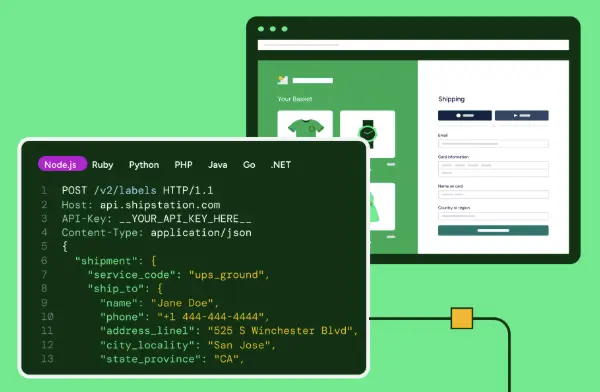
The ShipStation Carrier Network Program uses the ShipStation Developer Hub to provide self-service onboarding, allowing you to integrate quickly, sign your agreement, connect, and launch on your schedule.
For a regional or specialty carrier, growth often stalls at the software layer. Your service may be cheaper, faster, or better suited to a certain kind of parcel than the national options. But if a merchant’s shipping tool doesn’t connect to you, they never see that advantage.
What the merchant sees is friction. A second login. Manual label entry. Tracking numbers pasted back by hand. Every extra step is a reason to stick with an already built-in carrier, so merchants who might otherwise scale with you stay with the national carriers.
Building integrations one platform at a time doesn’t fix it either. Each one means another spec to learn, another review process, and another queue to wait in.
The ShipStation Carrier Network is a program that lets regional and specialty carriers integrate directly with ShipStation and the ShipStation API. Once you’re live, your services appear inside the workflows merchants already use to compare rates, buy labels, and ship orders.
It’s built for regional, last-mile, and specialized delivery networks that want more volume from online merchants and have, or can bring, a development team comfortable building against a REST API. You build and own the integration, so you decide when it starts and how it’s resourced. You don’t wait in line for someone else to build it.
Reach merchants who are already shipping. ShipStation powers the fulfillment engine for active, high-volume merchants who are already comparing options and buying labels.
Compete on service, not software. Inside ShipStation, you appear next to the national carriers. Merchants weigh your rates and service in the same view, so the decision comes down to what you offer rather than which carrier their software happened to support.
Remove the friction that holds merchants back. Once the integration is live, a merchant can ship with you from the same platform they use for everything else. There’s no separate portal and no manual rekeying. As their order volume grows, using you doesn’t become harder, so they can scale with you instead of around you.
Grow as ecommerce grows. As merchants ship more, your services are there alongside the options they already use.
Your engineers get a documented, standardized path rather than a custom project.
Self-service onboarding. The Developer Hub is where your team gets started: documentation, tools, and a consistent onboarding flow. You build against standard API specs, so your developers don’t have to learn a bespoke setup.
A clear process. Carriers move through the same steps:
Tested twice, so it holds up. Your team tests against our scenarios, then we test again before anything goes live. That second pass catches problems before merchants see them, so they can trust the integration. Merchants who have a good first experience with your service are more likely to keep using it.
Support throughout. Our team works with you from the first application through go-live.
Timing depends on your resources, how many questions come up, and how many QA rounds are needed. Some integrations take a couple of weeks. Others take longer.
If your carrier serves e-commerce merchants and your developers are comfortable with a REST API, the next step is a short application.
Apply to join the Carrier Network, and have your technical team explore the Developer Hub documentation before you start. In the meantime, send questions to [email protected].