Back






























































The Shipping Insights Report
Merchants can’t control carrier rates or trade policy, but they can control their response. By optimizing rates, improving cost visibility, using AI to act on insights, and reducing manual work, they can get more from every shipping dollar and expand globally with confidence.
Scroll to exploreMethodology: Based on an online survey conducted in September 2026 with responses from 1,600 decision-makers from US retail, manufacturing, wholesale/distribution, and transportation businesses with under 500 employees. All survey statistics are from this study unless otherwise noted.
Five truths the latest data reveals.
-
1
Carrier costs are taking a bigger bite out of margins. 52% of merchants cite rising carrier fees and fuel surcharges as a major operational hurdle, up from third place (31%) in our last survey.
-
2
Fulfillment spending remains high, making efficiency non-negotiable. 72% report climbing shipping and freight costs in just the past three months, with 35% still spending over 15% of revenue on shipping, freight, and fulfillment.
-
3
AI is moving from optional to essential. 34% identify AI as critical to growing their business, and 43% say customer expectations are rising.
-
4
Going global pays off, but it isn’t always easy. 62% ship outside the US, and 89% of those international shippers say tariffs, trade policy, or global disruptions have hurt their plans.
-
5
Resilient merchants are leaning in while competitors pull back. Undeterred by headwinds, 66% of international shippers expect volume to grow, and 42% plan to enter new markets, more than twice the 19% planning to retreat.
Rising carrier costs, shifting trade rules, and why shipping is your ultimate growth driver
Ask a merchant how business is going, and you’ll probably hear good news. Ask about shipping and the tone changes. Carrier fees and surcharges have climbed to the top of merchants’ list of difficulties, and shifting trade policy keeps rewriting the rules for cross-border sellers. Yet, forward-thinking businesses recognize a core reality: shipping is one of the strongest levers a brand has for customer acquisition and retention, and most of the businesses we surveyed say shipping will matter even more to their business next year.
To see how they are managing that tension, we surveyed 1,600 decision-makers across industries. This report breaks down their level of confidence, where shipping costs are squeezing margins, how AI can help teams take back control, and why ambitious companies are doubling down on international markets for their next phase of growth.
Merchants feel good about their business but uneasy about their shipping costs.
Merchants remain significantly more optimistic about their own businesses than about the broader economy, a gap that has held steady since our last report. But rising shipping costs are putting that confidence to the test.
The numbers show the split: 85% of merchants rate their current business health as good or excellent, but only 40% say the same of the economy.
That optimism is backed by solid performance. About half expect the economy to improve for businesses like theirs, and just as many say their business is doing better than a year ago.
But there’s one area where the mood turns: the cost of getting orders out the door. Shipping costs are the single biggest drag on optimism, with carrier surcharges and fuel fees leading the list of challenges.
And the pressure is compounding. Nearly three in four merchants (72%) saw shipping costs rise in the past three months, while almost none saw relief. The costs continue to climb, and the burden isn’t easing. Roughly a third still allocate more than 15% of revenue strictly to fulfillment, the same share as last time.
Instead of waiting for rates to drop, merchants are actively taking charge. Recognizing that fulfillment directly impacts brand loyalty and repeat purchases, more than half plan to invest more, even as they work to reduce shipping costs.
Market carrier rates and fuel charges may lie outside of a merchant’s control, but how businesses respond does not. Forward-thinking merchants instantly find the best rate on every shipment, automate tedious workflows, and gain complete visibility over where every fulfillment dollar goes. That’s where AI comes in.
AI helps merchants regain control of shipping costs.
Shipping and logistics have never been more complex, or more fragmented. Much of what makes shipping expensive is hidden in the day-to-day micro-inefficiencies: rates that vary by carrier, details entered by hand, and data scattered across systems.
Freight is a primary example. In our last survey, 58% of freight shippers ran operations through a provider disconnected from their parcel platform, so quotes, tracking, and invoices lived in separate places.
AI can connect the dots across parcel and freight, giving merchants a smarter, more complete view of their logistics so they see a single, clear picture instead of piecing it together from separate tools. Many businesses are acting fast: one in three call AI critical to growth, 43% face surging customer expectations, and most rate both parcel and freight extremely or very important to their operational model.
Comparing rates across carriers helps merchants avoid overpaying and capture better margins on every shipment, while preventing surprise charges like oversized-box fees. Soon, AI will go a step further, recommending the most cost-effective box before an order is packed, and automatically auditing carrier invoices against quoted rates to catch and dispute billing errors instantly, without anyone combing through statements. With AI, that smarter oversight applies across both parcel and freight.
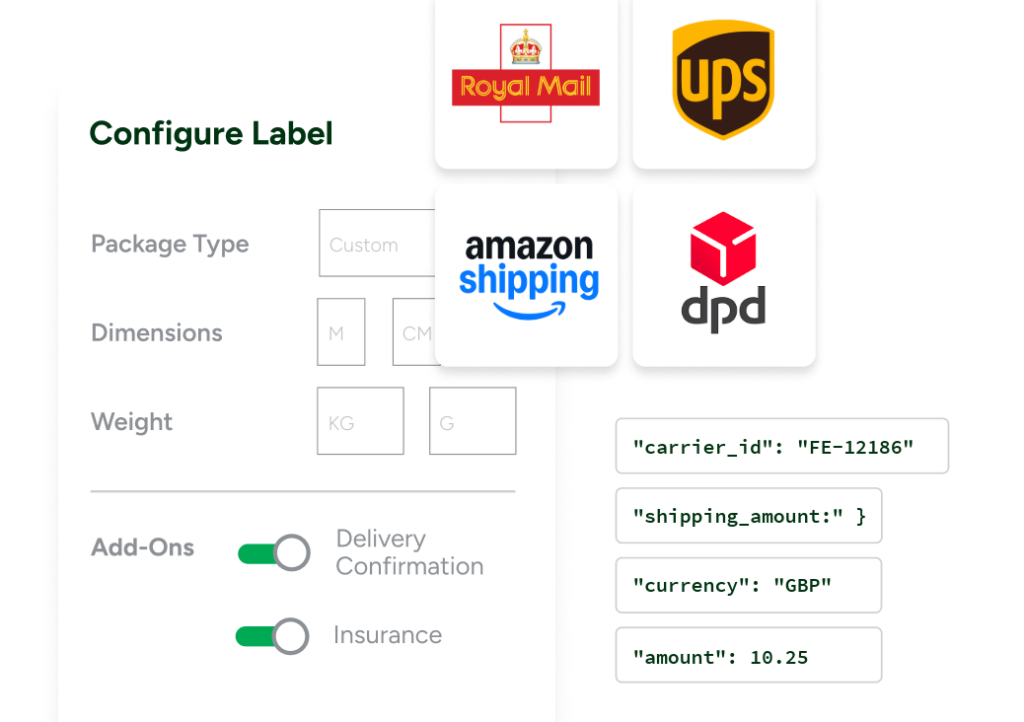
Automation that learns how a business ships and pre-fills weights, dimensions, and carrier settings takes repetitive entry off teams’ plates, giving them hours back and preventing the mistakes manual work invites. On the freight side, this approach extends to creating orders directly from incoming data and automatically attaching tracking numbers, freeing lean teams from digging through carrier portals. This provides crucial support for overburdened teams, especially as a growing share of businesses struggle to find or retain staff.
The operational efficiency gains are immediate, cutting shipment creation time by more than a third and LTL order setup time by over three quarters.
Clearer data shows merchants where costs are creeping up. Soon, merchants can ask plain-language questions, such as where shipping spend climbed last week, and get answers in seconds without building reports manually. And models that learn from carrier and network data are on the way to flag likely delays before they happen, while automation catches missed pickups and reschedules them without a phone call. The impact is clear: when asked to identify their biggest shipping challenge, nearly three in ten highlight delivery delays, carrier reliability, lost or damaged shipments, or tracking issues.
Together, these capabilities will give merchants a clearer, more connected view and help them maximize value from every shipping dollar without adding extra operational overhead.
The same AI that optimizes domestic shipping creates even greater leverage internationally, where complex regulations, customs friction, and unpredictable fees present the biggest barriers to scale.
International shipping is a path to growth, even with rising costs.
For growth-minded merchants, expansion no longer stops at the border. Most businesses we surveyed actively ship outside the US, using core international markets—typically Canada, the UK, and Mexico—as a proven springboard for global growth.
Those sales are meaningful without being overwhelming. Most international shippers get a modest share of revenue from abroad, making the next stage of growth less about taking a giant leap and more about perfecting something they’re already doing.
That’s despite a tough backdrop: tariffs, trade policy shifts, and global disruptions have impacted nearly nine in ten cross-border shippers. Among international shippers, the pressure shows up in several ways. Tariffs and shifting trade policy rank as a primary hurdle, followed by unpredictable costs, fuel fees, and carrier surcharges.
Much of that friction stems from the parts of cross-border shipping that are hardest to see in advance. Inaccurate customs declarations delay packages, duties and taxes vary unpredictably by destination, and the cheapest option on paper isn’t always the cheapest once everything is added up. Doing this manually creates administrative bottlenecks and unexpected costs. A unified shipping platform automates customs paperwork, compares rates across carriers by destination, and consolidates global tracking into one dashboard.
Yet ambitious merchants aren’t backing down. Most expect international volume to grow, and brands actively entering new markets outnumber those pulling back by more than two to one.
Winning internationally requires total landed-cost clarity. Over half of cross-border merchants currently rely on rough estimates before an international order ships, yet an overwhelming majority recognize that guaranteed, upfront duty and tax calculations are vital to conversion and retention. Providing clear landed costs upfront eliminates surprise fees at delivery—protecting seller margins and customer trust.
Cost clarity builds lasting customer loyalty. Global shoppers expect the exact same tracking visibility and easy return options they get at home. With one platform managing global labels, customs automation, tracking, and returns, entering a new market stops being a complex operational project and becomes just another shipping destination.
The merchants growing internationally understand the real cost before a package ships, keep their customs paperwork accurate, and give customers the same tracking and returns they expect at home. Set up that way, a new market stops being a project and becomes one more destination.
You can’t control carrier rates. You can control your response.
Today’s merchants are confident in their businesses and clear-eyed about cost realities. Carrier fees are climbing, tariffs are testing international plans, and the share of revenue going to shipping isn’t easing. While merchants can’t control carrier rates or trade policy, they can maintain full control over their operational response.
Winning in today’s market comes down to three strategic moves:
- Optimize every shipment: Compare real-time carrier rates for every shipment rather than defaulting to a single provider.
- Automate the busywork: Let AI handle repetitive tasks so teams can focus on growth.
- Eliminate cost surprises: Ensure complete cost transparency on every international shipment before it leaves the warehouse.
With a smarter, fully connected view of logistics across parcel and freight, merchants can maximize every shipping dollar and expand globally with total confidence.
Ready to make every shipping dollar work harder?
Discover how ShipStation can empower you to save money by finding the best rates, save time by automating fulfillment, and scale your business with confidence—at home or abroad.
Start a Free Trial