Back






































 Technology & Integrations


It’s day two for your newest seasonal picker. The pick list is a stack of paper. The bins aren’t labeled the way the list says they are. Orders are stacking up, and every one of them depends on someone reading a SKU correctly, grabbing the right quantity, and not getting distracted.
That’s not a people problem. It’s a process problem.
A warehouse barcode scanner moves the checkpoint from a person’s memory to a scan. It confirms the item, the quantity, and the order before anything leaves the building. When holiday volume overwhelms manual processes, that’s the difference between catching a mistake at the shelf and catching it in a customer’s inbox.
Here’s how warehouse barcode scanning keeps picking, receiving, and inventory counts accurate during peak, and what to look for before you buy.
Peak season doesn’t create warehouse errors. It exposes the ones you’ve been tolerating.
Manual data entry is the biggest culprit. Typing a SKU, eyeballing a quantity, ticking a line off a printed list: each step is fine on a quiet Tuesday. At 3x volume, with temp staff and a clock running, every step becomes a place for a mistake to slip through. Peak season is a systems problem, not a scheduling problem, and what breaks first at 10x volume is whatever relies on one person doing the same careful thing hundreds of times in a row.
Scanning replaces three habits:
It’s a reframe of where accuracy comes from.
Accuracy has to hold at three points: when the stock comes in, when it’s picked, and when it goes in the box. Scanning protects all three.
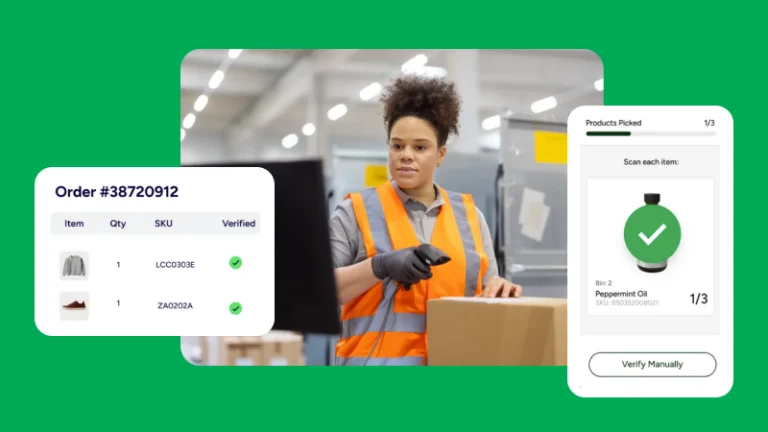
Mobile picking puts assigned batches on your team’s devices, so pickers confirm quantities as they go. If something comes up, they can pause and resume without losing progress, and flag exceptions such as low stock or substitutions. Over-pick prevention stops extra scans, so nobody grabs one too many. Pick-to-tote helps them fill more orders accurately in a single trip.
Mobile picking delivers a 30–40% increase in labor efficiency compared with printed pick lists. Your team does the same work with fewer wasted steps.
Scanning works best as part of a peak-season warehouse plan that gets your floor ready before the surge, not during it.
Receiving backlogs are quiet peak-season killers. The product sits in the dock, unavailable to sell, because someone has to count it in and key it into a system.
A warehouse inventory scanner changes that. With ShipStation’s Scan to Receive, merchants save an average of 10 hours a month on receiving by replacing manual CSV imports. Stock gets counted in faster, so it’s available to sell sooner.
Packing is your last chance to catch a mistake. At the station, staff scan a barcode on a product, a packing slip, or an order number to pull up the correct shipment. Then, Scan to Verify confirms that the SKU, quantity, and order match as each item goes in the box. You can set rules so a label only prints once everything checks out.
That one rule turns a late-stage surprise into an early correction. It’s one of the simplest ways to avoid common shipping mistakes before a package leaves the building. Add automation rules built before peak, and your team can handle exceptions while the system handles routine tasks.
Once orders are right, a multi-carrier strategy keeps them moving when capacity tightens.
Not every operation needs the same hardware. Here’s how the main options compare:
Handheld scanners for warehouse use are the workhorses. A barcode reader that warehouse teams can hold in one hand and trigger in a second is hard to beat for speed. RF terminals earn their place in big buildings where walking back to a workstation wastes time. Mobile devices are often the quickest path for growing brands, since the hardware is something your team already knows how to use.
Before you buy anything, check that your system supports the hardware you’re considering. ShipStation’s mobile picking runs on devices your team carries, and you can print barcodes right on pick lists and packing slips.
Accuracy at the bin is only half the story. The other half is knowing what you have, and where.
A barcode scanner for warehouse inventory feeds your counts every time stock moves. Barcode scanning delivers 99%+ inventory accuracy across physical and digital counts by removing manual entry errors. That matters most when volume surges, because counts that drift by a few units on a quiet day can drift by hundreds in December.
Warehouse scanning systems get more valuable with every location you add. With ShipStation, you link each Inventory Warehouse to a Ship From Location, so orders automatically route to the right site. When you add a facility, change 3PL partners, or consolidate stock, you update those links in a few clicks. No more juggling spreadsheets.
Location data shows up where your team needs it, too. Bin locations can print next to SKUs on packing slips, so pickers know exactly where to go. Less wandering, more picking.
Seasonal hires are your riskiest variable. They’re new, they’re fast-tracked, and they’re expected to hit the same accuracy as veterans on day one.
Guided workflows close that gap. A new picker doesn’t need to memorize where things live or how to read a SKU. They follow the device. The packing process is guided too, so new team members pack accurately from day one, and a label that only prints on a match gives everyone a safety net.
That’s how you scale output without scaling risk. And the platform can handle the load: ShipStation processed 28.5 million labels during Cyber Week 2024 with no performance lag.
Peak season doesn’t break warehouses. It breaks manual processes. Warehouse barcode scanning replaces typing, eyeballing, and memory with a scan at every step: picking, receiving, and packing.
Pair the right scanner with a warehouse management system barcode scanner workflow, and you get accurate counts across every location, faster onboarding for seasonal staff, and fewer mis-ships reaching customers.
With ShipStation’s mobile picking, Scan to Receive, and Scan to Verify, growing brands and enterprise teams can have a warehouse management system in place to keep holiday volume under control without adding more people to catch mistakes.
Don’t wait for the first mis-pick to find out what breaks. Start your free trial and put a scan at every step.