Back
Back


























































 Technology & Integrations


Ask sellers why they added Temu to their sales mix, and you’ll hear the same handful of reasons: traffic, speed, and a fast first sale. Before Sarah Gulfraz, founder of UK celebration brand Peacock Supplies, agreed to list a single product on Temu, she checked one thing first: did her shipping platform already connect to it?
This guide answers the most common questions ShipStation sellers ask about Temu’s Local Seller Program and explains the program, selling locations, onboarding steps, and available support.
Temu’s Local Seller Program lets eligible local businesses sell on Temu through local warehousing and delivery. Launched in early 2024 and now active in 37 markets, it was initially designed to help local sellers serve local consumers. The program is now gradually expanding to let eligible sellers reach nearby or regional markets, too.
Yes. Temu’s Local Seller Program is gradually opening nearby and regional markets to eligible sellers. In the European Union, eligible sellers can already sell across EU markets without being limited to a single country. For example, a seller based in Germany can sell into Belgium even without local warehousing there, using either Temu-supported logistics providers or their own arrangements.
Since early 2026, sellers in Germany, Italy, the Netherlands, Portugal, Spain, Romania, Belgium, Poland, and France have also been able to sell into the UK, Iceland, and Switzerland. In North America, US-based sellers have been able to sell into Canada since December 2025.
The benefit for sellers is broader reach without having to recreate their operations market by market. Eligible sellers can grow sales, reach more customers, and make better use of their existing capabilities as Temu expands the program over time.
Temu’s Local Seller Program helps businesses grow by making it easier to start selling online and reach more customers, both at home and abroad. It supports faster entry with no-cost onboarding, simple setup, and access to a large customer base through its discovery-based model.
Seller applications typically take about 10 minutes, approvals may come within one business day, many sellers go live within 72 hours, and around half make their first sale within 20 days.
Many sellers who’ve joined the program say they’ve reached new customer segments, expanded their market reach, created new revenue streams, and reinvested that growth into offline operations such as local hiring, warehouse expansion, and improved customer support.
Certainly. For many small and medium-sized businesses, Temu’s Local Seller Program can be a meaningful growth opportunity. Many smaller businesses face high upfront costs, hidden complexity, and customer-acquisition barriers when trying to sell online. Temu’s Local Seller Program is designed to lower those barriers through no-cost onboarding, easy setup, built-in tools, and access to a large audience through a discovery-based model. Instead of asking sellers to build everything alone, the platform connects them to traffic, infrastructure, and third-party services that can make growth more achievable. For smaller merchants, that can open a new path into ecommerce.
Temu’s Local Seller Program is currently available in: United States, Mexico, United Kingdom, Germany, France, Italy, the Netherlands, Spain, Belgium, Austria, Poland, the Czech Republic, Hungary, Romania, Sweden, Japan, the Republic of Korea, Canada, Australia, Portugal, Türkiye, Greece, Denmark, Finland, Bulgaria, Slovakia, Slovenia, Ireland, Lithuania, Croatia, Brazil, Estonia, Switzerland, the United Arab Emirates, Latvia, Cyprus, and Norway. Register at Temu Seller Center to check eligibility for your business.
Eligible sellers can list products in more than 700 categories, such as apparel, household electronics and gadgets, and everyday essentials. Temu supports a diverse mix of merchants, from family-run brands and traditional manufacturers to wholesale distributors and multinational retailers.
Getting started usually involves four steps: creating a seller account, submitting your business information, verifying the business representative, and completing your shop setup. Based on our US registration flow, the process typically works like this:
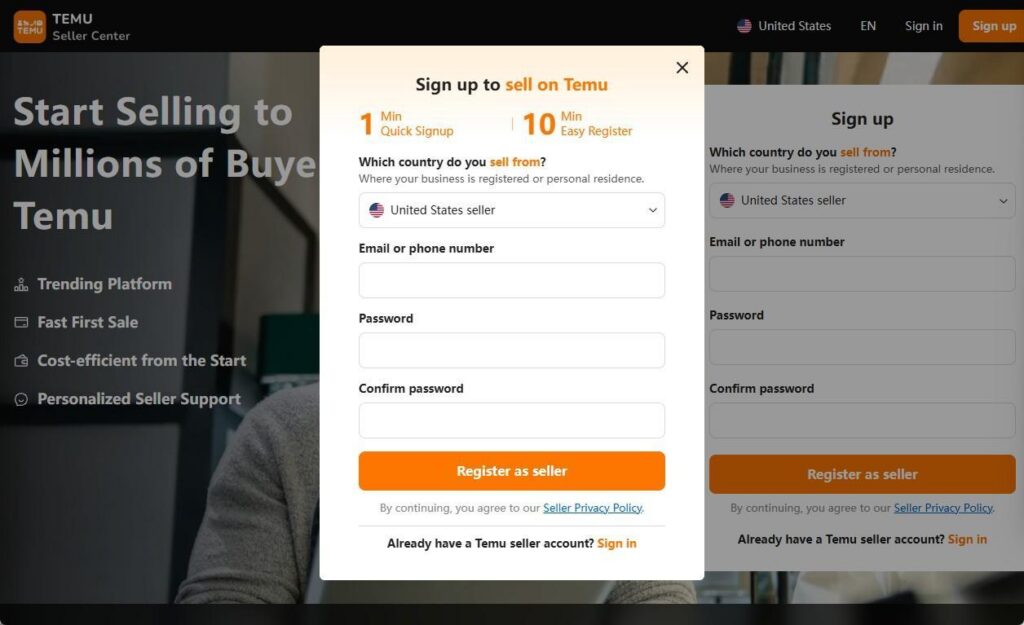
Start at Temu Seller Center and click Sign up. Enter your email address or phone number and create a password of at least eight characters, using a combination of letters, numbers, and symbols. Don’t use your email address or email prefix as part of your password. Click Register as seller to begin.
After registration, you’ll land on the Business information page. First, choose your business location. Then select the business type that matches your setup:

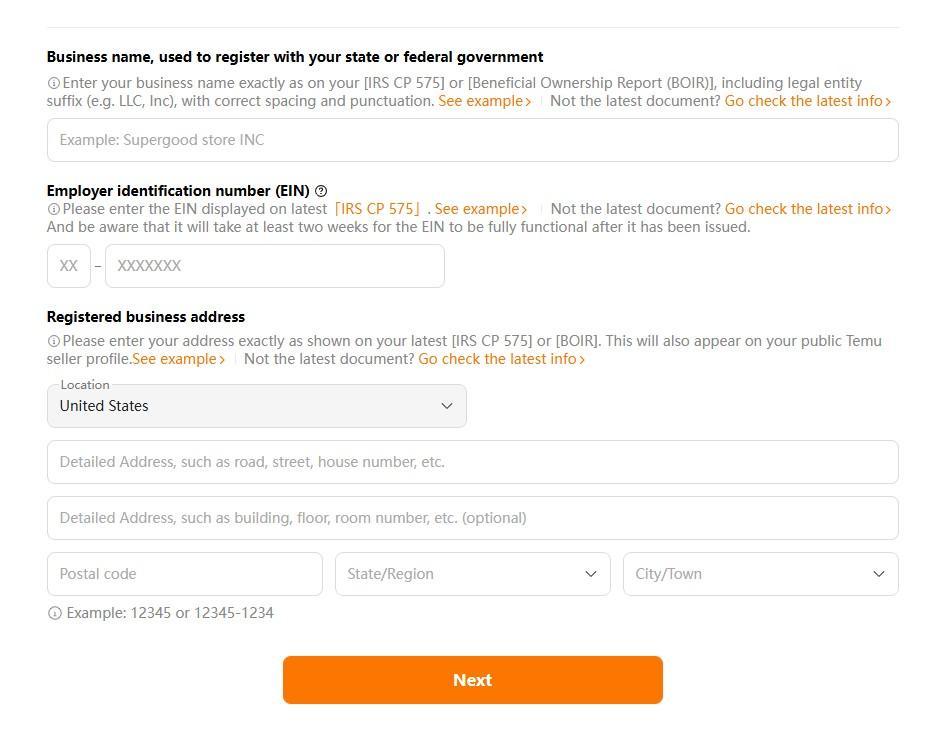
If you selected sole proprietorship, corporation, or partnership, you’ll need to enter your business registration details, typically your registered business name, Employer Identification Number (EIN), and registered business address. Make sure the information matches your official registration documents.
After submitting your business information, you’ll move to the Seller information step to verify the business representative. Select the country or region that issued the ID, choose the representative’s ID type, and upload an ID photo for identity verification. This step is supported by Jumio, an identity-verification provider that helps businesses verify IDs online and detect fraud. You can take photos online or upload the ID from your device. The file must be smaller than 4 MB, in JPG, JPEG, or PNG format, valid and not expired, and clear enough to show all four corners.
Once the ID is uploaded, enter the representative’s details exactly as shown on the document, including their legal name, ID number, ID expiry date, citizenship, place of birth, and date of birth, along with their address information. For more information, please visit the Temu Seller Academy.


Temu supports sellers with a mix of platform infrastructure, operational tools, and service resources designed to make selling easier and more efficient. That includes dedicated seller support teams who can answer questions and help resolve issues quickly, along with access to large-scale platform traffic, direct customer engagement features, and ERP integrations. Temu also works with logistics and payment partners to support fulfillment and transactions. Together, these resources help sellers streamline operations, manage orders more efficiently, and grow without building every capability alone.
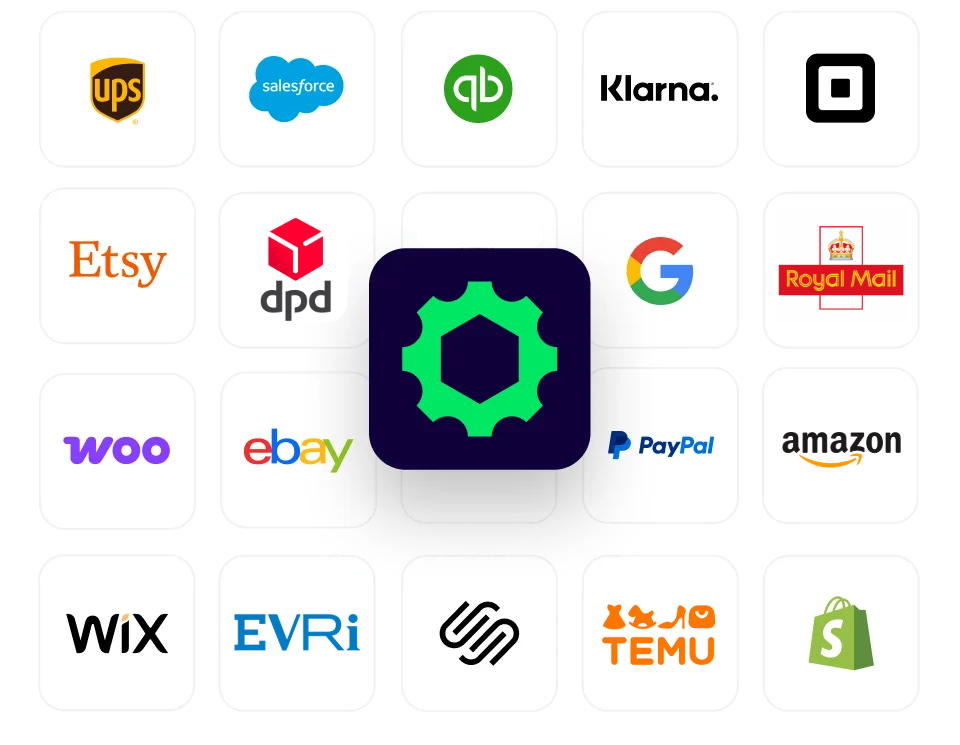
Temu works with logistics partners including USPS, UPS, and DHL, and with payment providers such as Google Pay, Apple Pay, PayPal, and Visa. It also partners with ERP and fulfillment providers, including Rithum, ShipBob, ShipStation, and Linnworks, to help streamline order management and seller operations. In Europe, Temu partners with more than 150 logistics providers and has strategic partnerships with 10 national postal service operators.
Whether or not ShipStation has an integration is one of our key deciding factors whether we’re going to work with the marketplace or not.
Yes. Across the globe, many sellers have already found success on the program.
In the US, Shop Succulents, a California-based live plant seller, joined Temu in February 2025 and generated about 3,500 sales in its first four months, nearly half of what it had sold on another platform over the previous decade. By April 2026, its cumulative sales on Temu had surpassed 11,000 orders—a striking result for a live-plant business, a category where ecommerce growth is often constrained by packaging demands and the challenges of shipping fragile, perishable products.
PopMarket, a US collectibles and entertainment retailer owned by Nasdaq-listed Alliance Entertainment, began selling on Temu in late 2024. PopMarket said Temu is its fastest-growing digital marketplace in more than a decade. In its first eight months, it sold more than 450,000 items.
New York-based premium steak and perishable food seller Grumpy Butcher grew ecommerce sales by 12% within its first five weeks. Illinois-based, family-run patch maker Patch Party Club sold more than 300 patches within three weeks of joining, with about 90% of sales coming from new customers.
In Europe, Mcslots, a family-run UK toy retailer founded by Mark Crowhurst, turned to Temu in 2025 after a broader slowdown in toy demand. After listing a small portion of its 3,900-product inventory as a test, orders started coming in within 48 hours; three months later, daily orders were up more than 40%, with Temu contributing half of total sales.
Ubedia, a France-based startup founded by two 23-year-old entrepreneurs, joined Temu in September 2025, just weeks after launching its ube powder business. It sold more than 1,300 units in its first three months, giving the founders enough traction and cash flow to quit their day jobs and run the business full time.
AMF Creation, a Germany-based tablecloth manufacturer, expanded its reach across the EU through Temu, and Fruta de Toro, a Spain-based fruit producer, launched its first direct-to-consumer online presence on the platform.
Temu’s Local Seller Program can be an alternative to more established marketplace models that make it harder for smaller sellers to gain visibility. Temu emphasizes a discovery-based approach and gives sellers the flexibility to choose their own logistics and service providers. The idea of that third-party partnership approach is to broaden participation by local businesses instead of concentrating advantages in the hands of a few large players. For merchants, that can mean greater control over how they operate, fulfill orders, and scale.
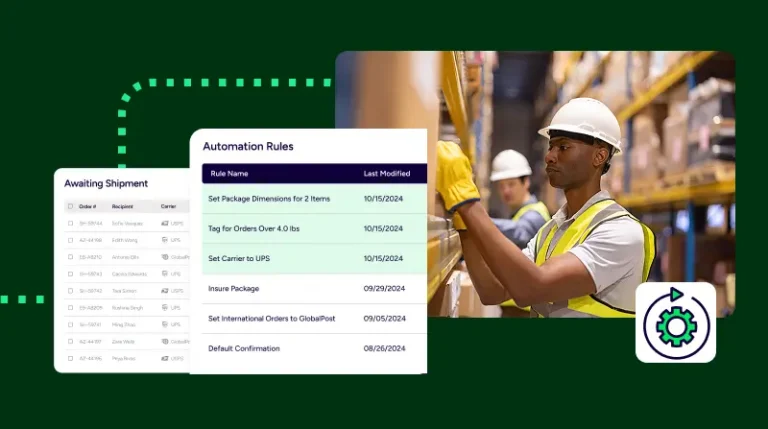
Whether you’re weighing the Local Seller Program for the first time or already have products listed, the operational question is the same one Gulfraz asked: how will these orders fit into everything else you ship? See how ShipStation connects with Temu, so every order—from Temu and every other channel you sell on—lands in one dashboard, running on the same automation rules you already trust.