Back
Back
































































 Tech & UK Integrations



Every ecommerce platform, marketplace, or fulfilment tool eventually hits the same wall: shipping. Your business needs to rate-shop, generate compliant labels, validate addresses, track packages, and process returns—across every carrier your customers expect to see at checkout.
Build that in-house, and you’re not writing one integration. You’re writing one per carrier, then maintaining all of them on each carrier’s own schedule. For a small or mid-market engineering team, that’s weeks of build time up front and a lasting drag on the roadmap.
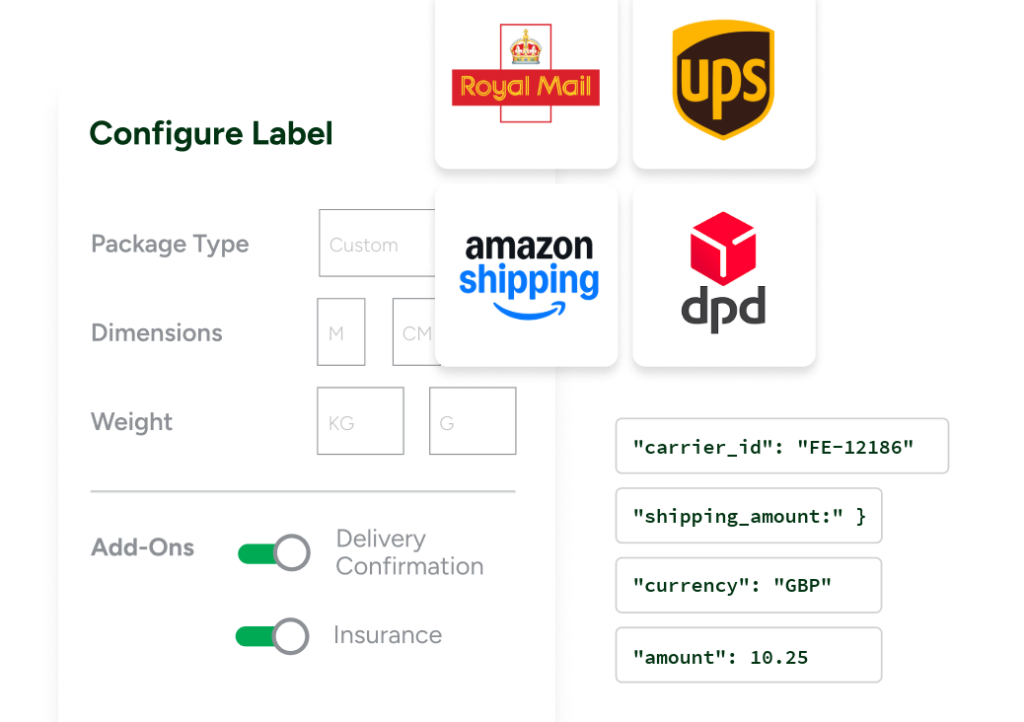
Comparing carrier rates, generating a compliant label, validating an address, tracking a shipment, processing a return—each looks like a single feature until you build it. Every carrier exposes this differently with separate authentication, label formats, address-validation edge cases, and webhook behaviour for tracking updates. Get one wrong, and it shows up downstream. A customer sees an inflated rate at checkout, a label fails to print, or a package goes untracked.
Carriers don’t hold still, either. They change specs, launch a new service tier, or shift compliance requirements. If you’ve built direct integrations, someone on your team has to catch it, adapt, and ship a fix before it breaks production. That ongoing maintenance is the part most teams underestimate when they scope the work required to build their own shipping experience. It doesn’t show up in the initial engineering estimate, but in every quarter after, pulling engineers off the product roadmap to keep shipping working.
ShipStation’s API removes that tax at the source. Instead of wiring up and maintaining a separate integration per carrier, your team builds once against a single, well-documented API and gets access to over 200 carriers and 400+ integrations, spanning 250+ territories.
That’s the pivot: when a carrier changes a spec, adds a service, or updates a compliance requirement, that update happens inside ShipStation’a API—not as a fire drill on your team’s backlog. Your engineers keep building the product your customers pay for; the carrier layer underneath keeps working on its own.
Compare that to piecing together a pure-API alternative: the carrier connections might be there, but every routing rule, retry, and webhook is still yours to write, test, and maintain. With ShipStation’s API, you get the connectivity and the plumbing underneath it.
Accurate where it counts. Rate shopping, labels, tracking, and returns aren’t bolt-ons here—they’re core, tested parts of the API. These are exactly the things that quietly break conversion and inflate support load when they’re wrong. Instead, your customers see accurate rates and working labels on the first try, not the third—backed by a 96% customer satisfaction score.
Built to be relied on. Shipping sits in your critical path, so reliability isn’t optional. ShipStation’s API is built for production use at scale: 99.99% uptime, and during peak season, the platform processes over 100 million API responses at an average of 229 milliseconds with zero outages—the kind of load that exposes gaps in scaling and retry logic on infrastructure-only platforms, where that responsibility sits entirely with your engineering team.
Fast to build, cheap to maintain. The real cost of a shipping integration shows up months after launch, not on day one. Teams choose ShipStation’s API because it collapses time-to-first-label. A developer can register and start testing immediately, without waiting on a support ticket just to get an API key—and then keeps the maintenance burden off the backlog, so engineers stay focused on the roadmap instead of carrier upkeep.
Flexibility without lock-in. A unified API doesn’t mean a constrained one. You still choose which carriers to surface, how rate logic gets applied, and how label and tracking data flow into your own systems. It also means you’re not locked into a pure-API approach if your needs change: optional no-code automation and batch tooling are there if an ops team ever needs hands-on visibility, without adding a second vendor to your stack.
A small engineering team had a single warehouse customer buying up to 10,000 shipping labels a month. They needed label creation built directly into their own product, so they evaluated a handful of shipping APIs before choosing ShipStation’s API.
The deciding factor wasn’t a feature checklist—it was how fast they could get moving. A developer could register and start testing immediately, while some alternatives required contacting support just to get an API key, on top of documentation the team found hard to follow.
Shipping will always be part of your product, but it doesn’t have to be a permanent maintenance project or a second system you build yourself. Teams building on ShipStation’s API trade integration debt for carrier reach, consistent rates, and labels that work—one API, not one per carrier.
Explore the docs, sign up, or book a technical walkthrough with our team.