Back
Back









































 Shipping Basics
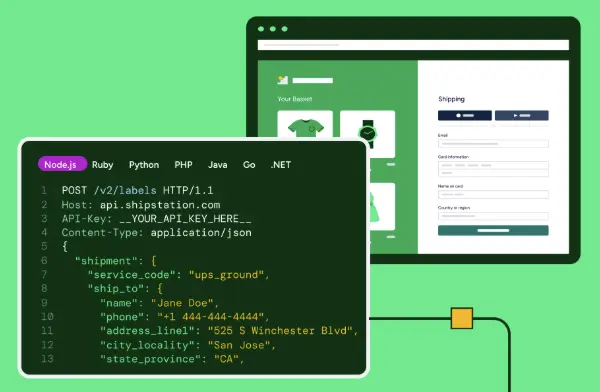


At some point in the last few years, you may have invested in your fulfillment operation. Maybe it started with getting all your orders into one place. Then you automated some of the repetitive decisions—shipment routing rules, batch label printing, and carrier selection. You connected your sales channels. You brought inventory under control. You got serious about comparing shipping rates.
The result is a fulfillment stack that actually works. Orders come in, labels go out, customers get their packages. The system runs.
And yet, somewhere in the middle of a normal workday, someone on your team runs out of boxes. Or tape. Or the right label stock. And everything stops while they figure out where to get more supplies.
That pause is a sign your fulfillment stack has a shipping supply problem. And it’s more expensive than it looks.
The right shipping software streamlines ecommerce fulfillment. Order management centralizes channels that previously required separate logins. Automation handles decisions that once needed human review for every order. Rate shopping surfaces the best carrier without a manual comparison. Inventory systems flag reorder points before stock runs out.
The pattern is the same throughout: take something manual, error-prone, and disconnected, and bring it into the system.
Unfortunately, for many ecommerce retailers, supplies didn’t make it into that system. Most ecommerce retailers still manage them the old way. Someone notices you’re running low, opens a separate tab, logs into a supplier account they check once a month, places an order, and hopes it arrives in time.
That mismatch is the supplies problem. Supplies aren’t hard to get—sourcing them just sits completely outside the flow of everything else you’ve built.
Supply disruptions rarely show up as one dramatic failure. They show up as a string of small ones: a warehouse manager pausing fulfillment to order boxes, an operations lead losing fifteen minutes tracking down whether anyone’s already reordered tape, someone discovering mid-shift that the label rolls are the wrong size.
None of that is catastrophic alone. Together, it’s a persistent drag nobody’s adding up—the cost of context switching. Productivity drops every time your team stops on a task, handles something unrelated, and tries to pick up the original thread again. If that’s happening several times a week, across multiple people, that’s real time and focus lost to a problem that has nothing to do with shipping.
The fix isn’t discipline or better checklists. It’s closing the gap between where you manage shipping and where you source supplies.
How many vendors does your team source supplies from? Probably a go-to for boxes, a different one for label rolls, and a fallback for when the usual supplier is out.
Each relationship adds overhead: separate accounts, separate billing, different lead times, pricing nobody’s fully memorized. And there’s a risk that rarely comes up until it’s a problem—compatibility. Will this label roll work with your printer? Will this scale talk to your software? When you buy from a general retailer, that’s your problem to solve.
Nobody sets out to build vendor sprawl. It happens because supplies don’t have a home in your stack, and buying from scattered sources slowly turns into a collection of relationships that add friction to an already complex operation.
Bringing supplies into your fulfillment platform doesn’t just consolidate purchasing. It removes the overhead of managing relationships that shouldn’t have multiplied in the first place.
The costliest version of the supplies problem isn’t tab-switching or vendor sprawl. It’s the stockout at the worst possible moment.
You can anticipate volume spikes and plan around peak seasons and promotions. What you can’t easily know is exactly how many supplies you’ll burn through over the next two weeks, given where your shipping volume stands today.
Your shipping software, though, already knows. It sees your order volume, shipment history, and seasonal trends. It knows if your current pace will exhaust your box inventory before your next scheduled reorder, and that label consumption jumped 60% before last year’s big sale. That data exists—it just doesn’t reach your purchasing decisions if supplies live in a separate system.
So reordering stays reactive: you order when you notice you’re low, scramble when you run out, and over-purchase as a buffer, tying up capital in inventory sitting on shelves. It’s a solvable problem, but only once supplies are part of the same stack as everything else.
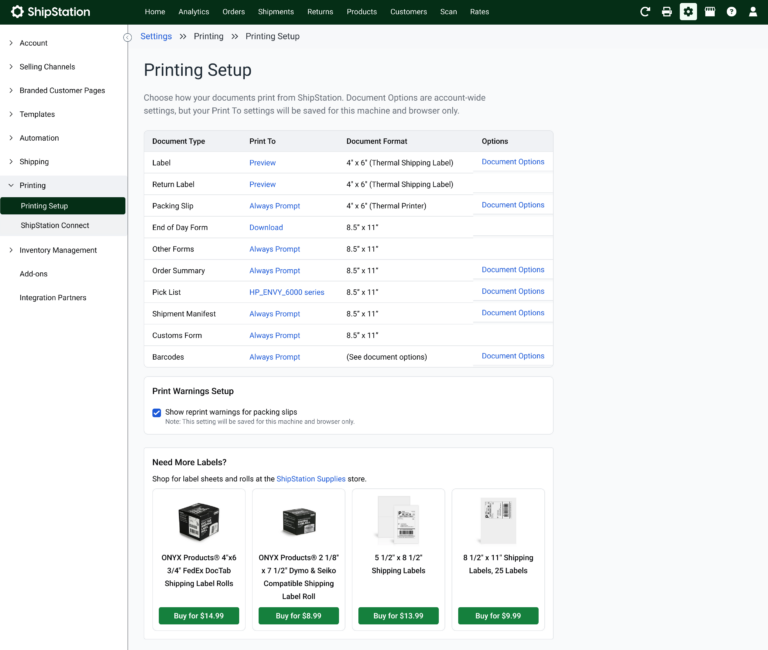
Bring supply sourcing into your fulfillment platform, and the benefits start immediately, then compound.
Reordering happens where you already manage the rest of your work, so the cost of interruption disappears. Every product has already been tested on your setup, so compatibility is no longer a guessing game. Vendor overhead shrinks to a single place and a single checkout, often with bundling savings that scattered purchasing can’t match. A platform that sees both your shipping volume and your supply purchasing can start closing the gap between what you need and when you need it, turning reordering from reactive to proactive.
Closing the supplies gap isn’t just about convenience. It’s a more coherent operation, with one more piece of the workflow connected to everything else.
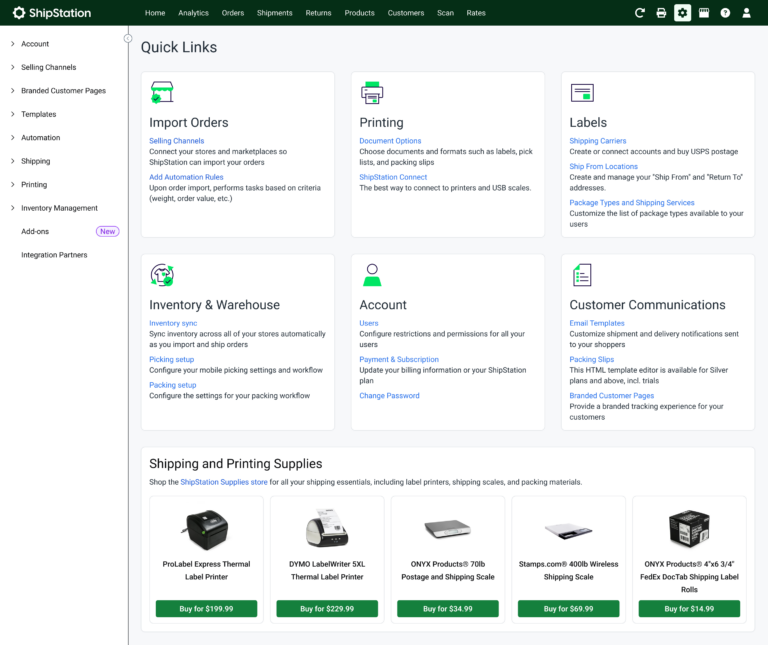
If your fulfillment stack has a supplies problem, the ShipStation Supplies Store is where you fix it.