Back












































 Peak Season


Deals now start in October. The shipping rush still arrives all at once.
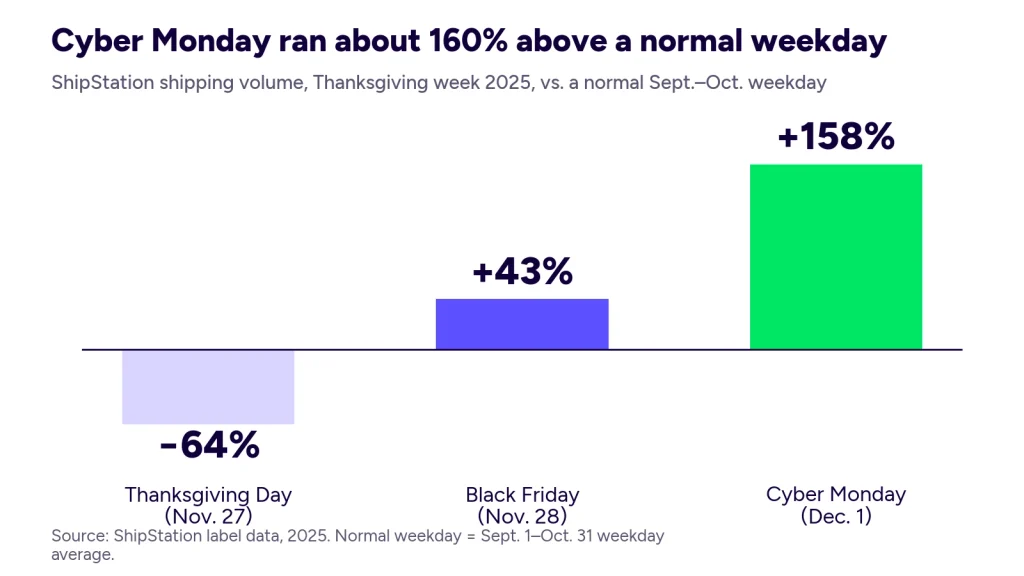
ShipStation’s shipping data shows how that played out in Thanksgiving week 2025. On Thanksgiving Day, shipping volume sat 64% below a normal weekday. On Black Friday, it ran 43% above. On Cyber Monday, it ran 158% above.
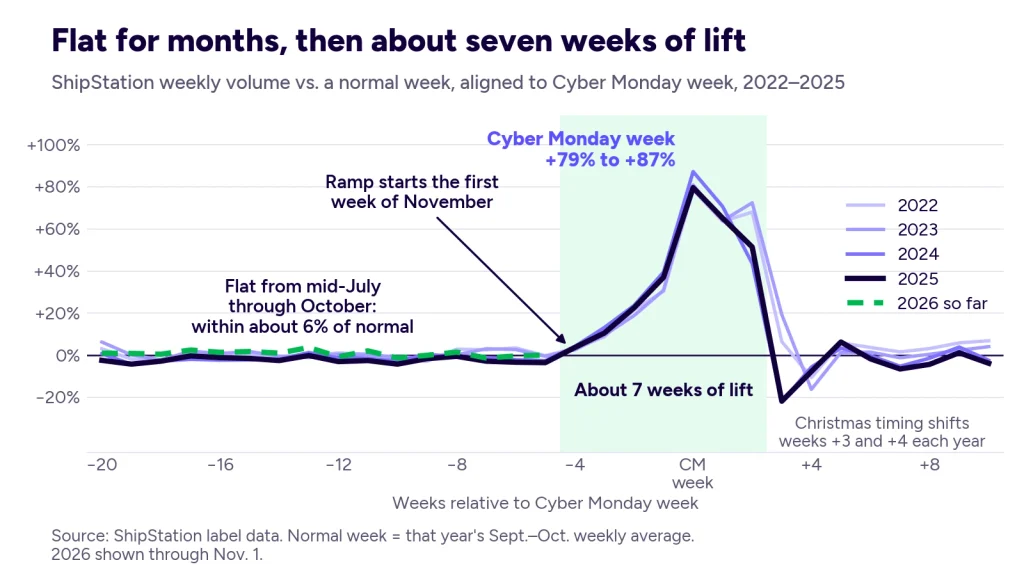
That spike followed months of flat volume. From mid-July through October, weekly volume stayed within about 6% of normal, even as deals crept earlier in the calendar.
Black Friday Cyber Monday shipping still peaks on a single Monday while the shopping calendar widens around it. In 2026, that Monday is Nov. 30. The data shows where shopping and shipping part ways, how the gap is changing, and what to fix before then.
The sales calendar keeps getting longer. Adobe expects US online holiday spending to reach $275.1 billion this season, with October spending up about 8%. Discounts are forecast to peak at up to 30% off during Cyber Week, then hold at 10% to 15% through December.
Shoppers are moving earlier too. The National Retail Federation (NRF) found that 43% of holiday shoppers plan to start before November, though 64% still expect to do most of their shopping over Thanksgiving weekend. Even so, Adobe puts Cyber Week, the five days from Thanksgiving through Cyber Monday, at about 17% of the season’s online spending.

You can stretch a promotion across six weeks, but you can’t change how shoppers behave over a holiday weekend. Consumers hold out for peak Cyber Week discounts, and while orders pile up from Thursday night through Sunday, holiday pickup schedules can push some shipments into Monday. By the time Monday arrives, warehouses aren’t just shipping Cyber Monday orders—they’re working through weekend orders as new orders come in.
Weekly shipping volume tells a different story. From mid-July through October, it stayed within about 6% of a normal week in every year since 2022. This year’s lead-in, through Nov. 1, looks the same.
The lift starts in the first week of November, about four weeks before Cyber Monday week. Volume runs roughly 3% to 4% above normal that week. It then climbs to 9% to 13%, then 19% to 24%, and 30% to 40% in Thanksgiving week. Cyber Monday week lands 79% to 87% above normal.
The two weeks after stay roughly 45% to 70% above normal, through about Dec. 20. Volume is back to normal by the first full week of January. In all, the lift lasts about seven weeks in a year that otherwise runs flat.
Within the peak, the balance is shifting. Since 2022, Black Friday shipping volume is up about 6%, while Cyber Monday is roughly flat. Black Friday now runs at about 56% of Cyber Monday’s volume, up from about 52%. Cyber Monday’s lead over Black Friday has narrowed from about 94% to about 80%.
Adobe sees the same trend in spending. Black Friday is forecast to grow 9.2% this year, ahead of 6.2% for Cyber Monday.
Cyber Monday still wins. Cyber Week now accounts for about 9.4% of ShipStation’s November and December volume, up from about 8.9% in 2022. That’s five days. Saturday and Sunday after Thanksgiving ran 260% to 280% above a normal weekend day, and Monday ran 158% above a normal weekday.
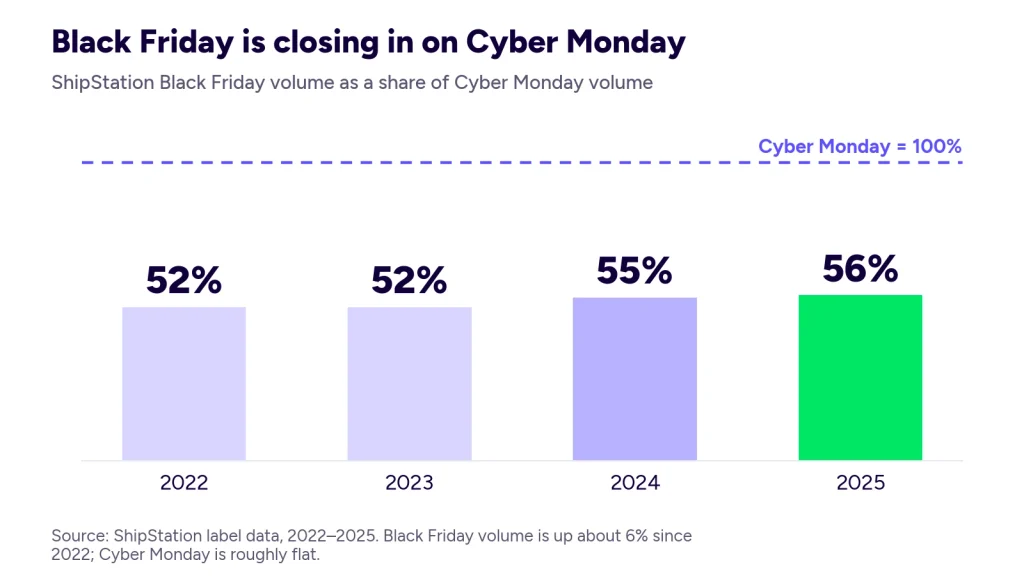
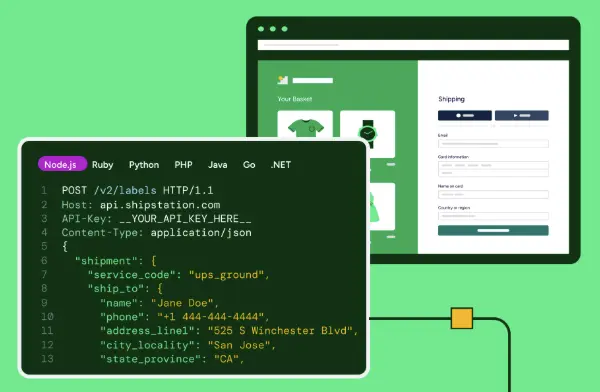
The gap between Black Friday and Cyber Monday is disappearing, which means the luxury of catching up on Monday is gone. Existing sellers are pushing 81% more volume through the same warehouse doors, so plan your weekend staffing around when orders come in and when carriers can pick them up. Automating order sorting, batching and label printing helps your team get more of Friday’s orders ready over the weekend and keeps Monday’s volume manageable.
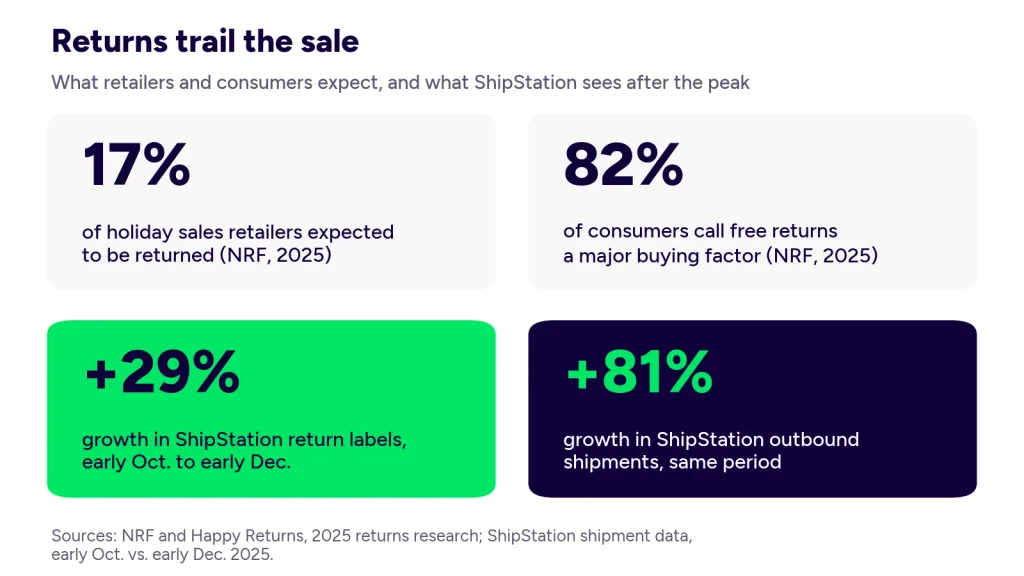
Black Friday Cyber Monday shipping volume doesn’t come from a wave of new sellers. Between early October and early December 2025, the number of sellers shipping grew about 4%. Their shipments grew 81%. The same sellers simply shipped far more.
Not every product peaks on the same day. Adobe expects the deepest discounts on TVs, toys, apparel, appliances, and furniture to land on Black Friday, while electronics and computers hit their deepest discounts on Cyber Monday. Adobe also forecasts online sales in grocery, toys, and cosmetics to grow roughly 10% this season, ahead of the 6.7% forecast for the season overall.
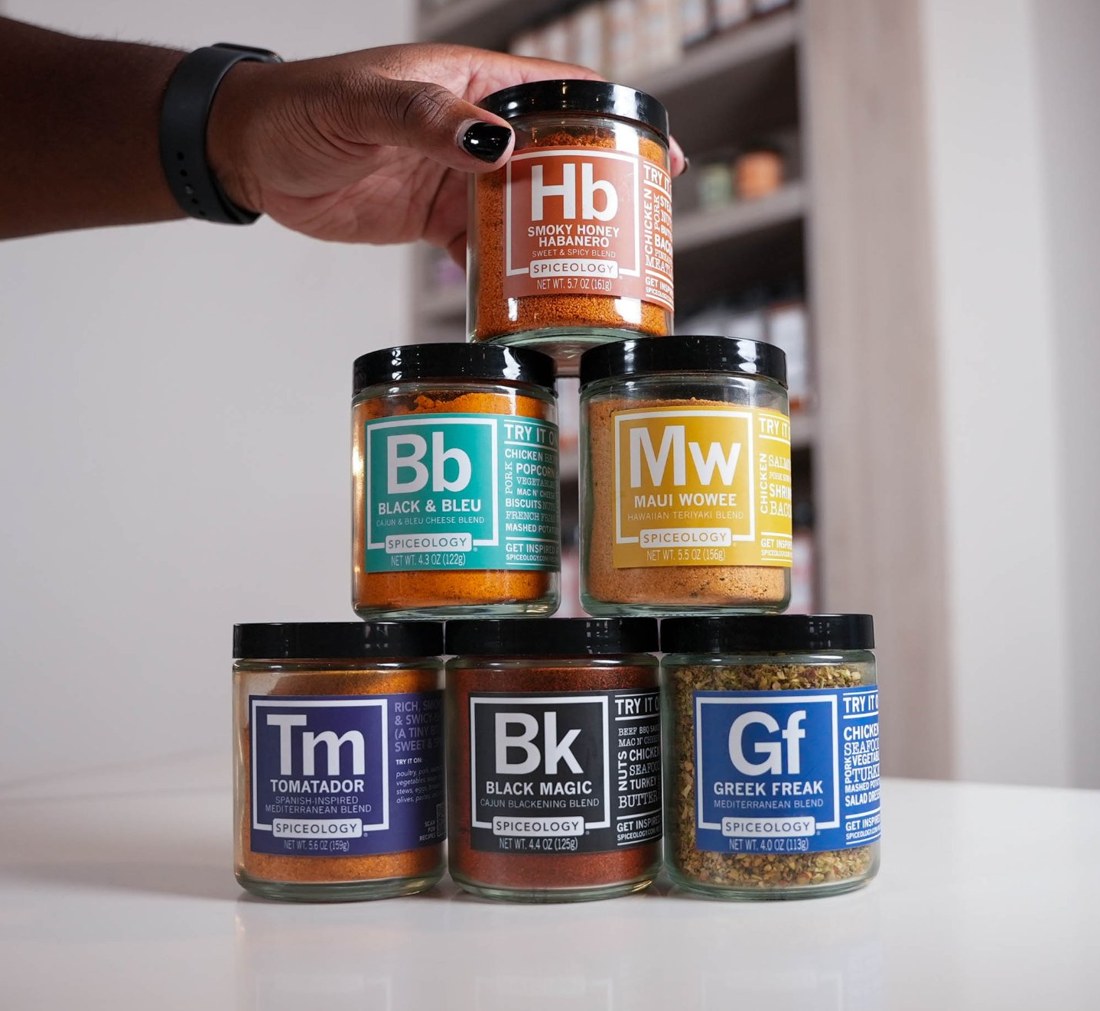
Whatever the category, the pressure lands on the packing line. Spiceology, a spice brand with more than 450 blends, can ship about three times its normal daily volume during its Black Friday sale. It does that without adding headcount or a peak-season night shift.
A ShipStation customer story
Peak pricing starts before the first sale. UPS, USPS, and FedEx each add temporary holiday pricing to help manage the surge in volume, starting as early as late September. UPS and FedEx step it up again for the busiest weeks, and most of it runs into mid-January.
Because the charges apply package by package, a heavy Cyber Monday adds up fast. Higher-volume shippers can also face added charges tied to how far peak volume runs above normal.
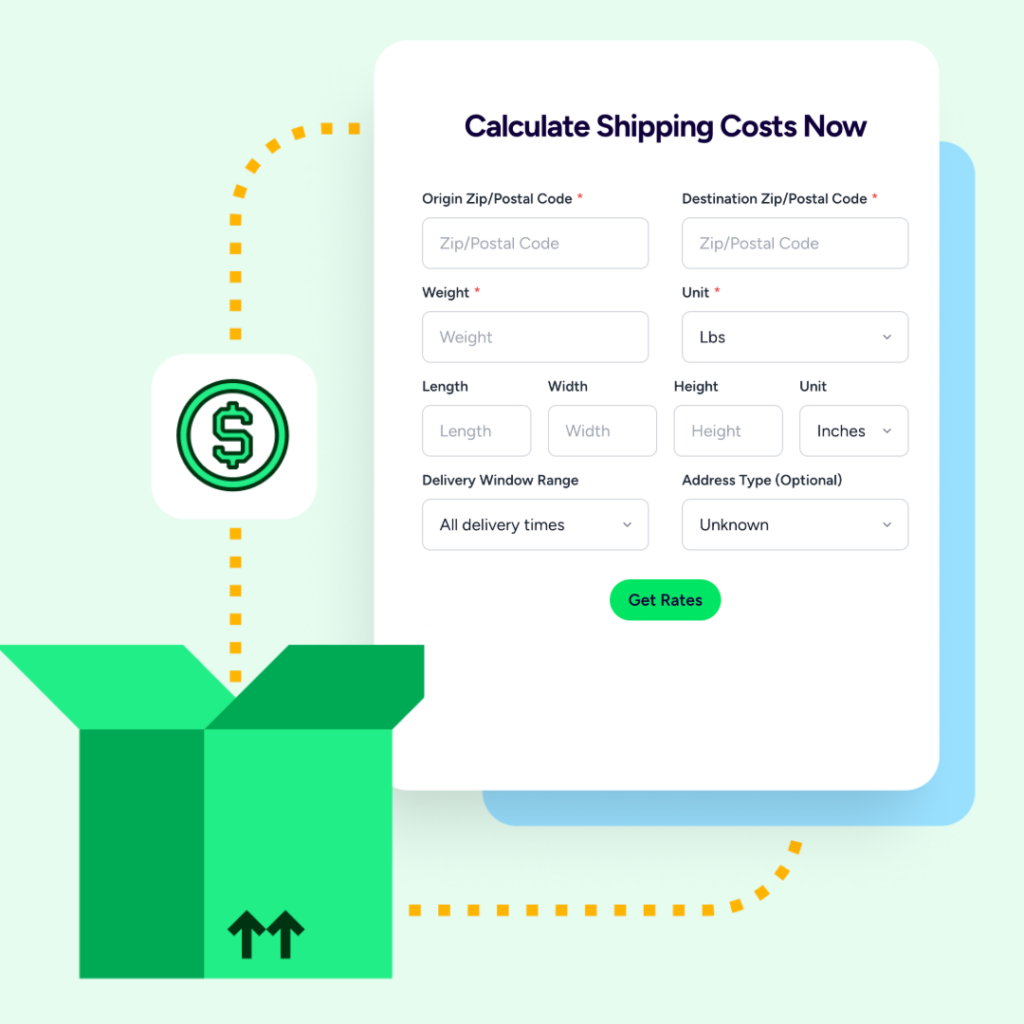
That makes Black Friday Cyber Monday shipping a cost question as much as a capacity question. ShipStation’s rate shopping compares parcel and freight options at label time. Each order can then ship on the cheapest service that still meets its delivery promise. Peak pricing also steps down after Christmas, so restocks shipped in early January cost less.
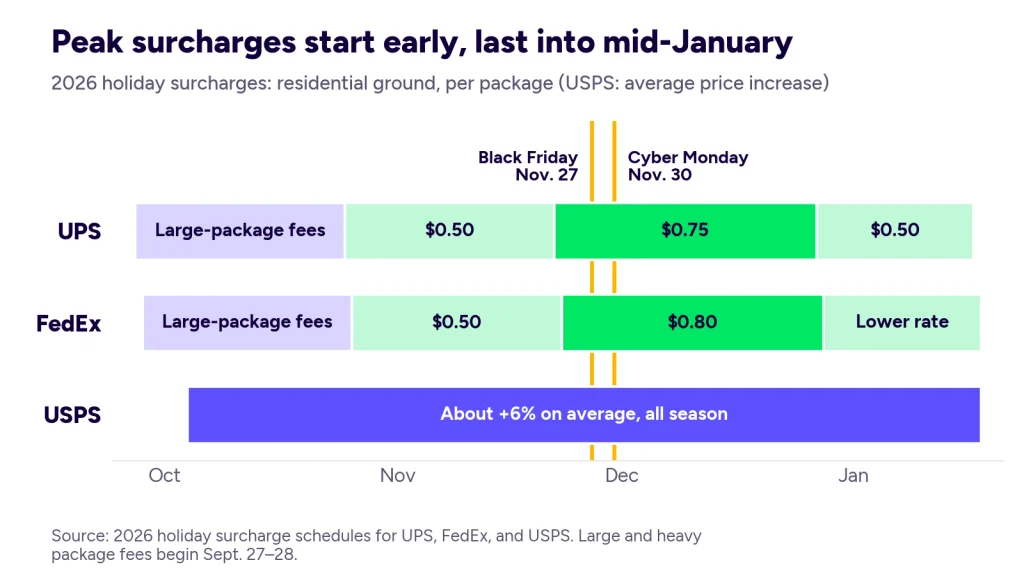
During Cyber Week, retailers have to get more orders out the door while keeping shipping costs in check. Start with the carriers and services that fit your business, and have backup options where you need them. As capacity and peak surcharges change, rate shopping can compare rates and delivery speeds across the services you use, so you can choose the lowest-cost option that still meets your delivery promise.
Outbound volume is only half the story. NRF’s 2025 research found that retailers expect about 17% of holiday sales to come back. It also found that 82% of consumers call free returns a major factor in where they buy.
Between early October and early December, return labels grew about 29%, compared with 81% for outbound shipments. Returns trail the purchases they come from, so the wave likely crests in January. A clear return window published before Nov. 27 heads off the questions that follow. Prepaid return labels and self-serve returns, both available in ShipStation, keep the January wave out of the support queue.
A ready Black Friday Cyber Monday shipping operation looks like this:
Six signs you’re in good shape
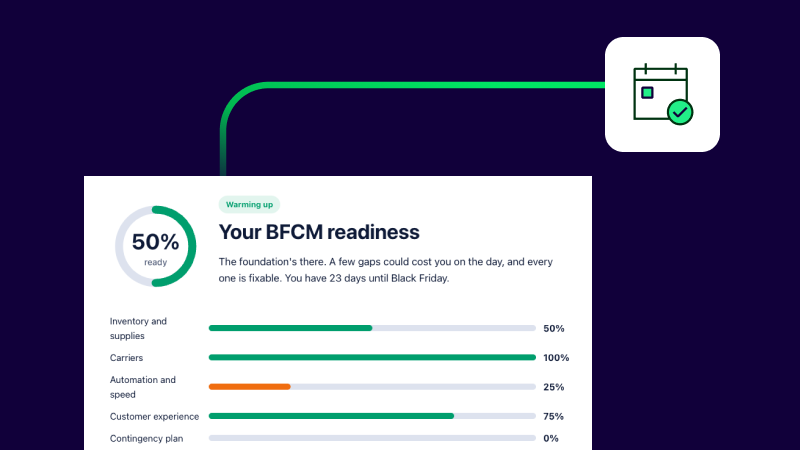
Take the Black Friday and Cyber Monday Readiness Quiz
Get your readiness score, tips to close each gap, and a dated plan
Small teams should start with automation rules and customer messaging, since both protect every order without extra hands. Enterprise teams should test carrier switching early. Print a label through each connected carrier now, so a delay or surcharge on Nov. 30 doesn’t force the first try.
Not sure where your operation stands? The Black Friday and Cyber Monday Readiness Quiz scores each of these areas and flags the weakest. The full results include tips for closing each gap and a dated plan built around Nov. 27 and Nov. 30. Fix the lowest score first. Finishing one fix beats starting three.
In the weeks leading up, walk through what happens from checkout to label printing and fix the one step most likely to slow fulfillment down on Cyber Monday. If your team is choosing a shipping service and package type by hand for every order, set up rules to make those choices automatically. If you’re counting on a backup service to handle overflow, print a test label now. Lock in and stress-test the fixes now, so your team can spend Cyber week packing boxes, not fixing workflows.
Black Friday Cyber Monday shipping rewards the sellers who prepare for the Monday, not the season around it. Take the quiz to see where your operation stands, then use the dated plan to close the gaps before Nov. 30.
Get peak season-ready with ShipStation today.