Back






























































 Shipping & Fulfillment


Shipping is part of your pricing, not an afterthought. Get it wrong, and you either lose margin on every parcel or lose customers at checkout.
This guide shows you how to work out what a parcel really costs to send, and how to charge customers in a way that protects your margin and complies with the UK’s rules on displaying delivery prices.
Weight. Start with the total weight of the parcel, including the box, inserts, and packing materials. Each carrier and service has its own weight bands and limits, so a few grams can push you into a more expensive band. Weigh parcels on a reliable set of digital scales, and do it the same way every time.
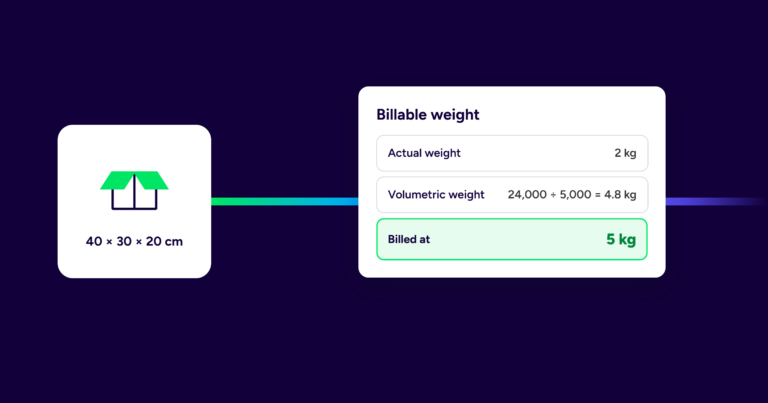
Size and volumetric weight. Carriers don’t only care how heavy a parcel is. Some also charge for the space it takes up, which is called volumetric or dimensional weight. UPS, for example, multiplies the length, width, and height in centimetres, divides by 5,000, and rounds any fraction up to the next half kilogram. It then bills whichever is greater, the actual weight or the dimensional weight. A parcel measuring 40 x 30 x 20 cm that weighs 2 kg has a dimensional weight of 24,000 ÷ 5,000 = 4.8 kg, which rounds up to 5 kg. UPS would bill for 5 kg, not 2 kg. UPS parcels can weigh up to 70 kg and be up to 274 cm long, but parcels dropped off at a UPS Access Point have lower limits: 20 kg and 97 cm.
Other carriers work differently. Evri bases its pricing on weight rather than size, with a 15 kg limit and parcels up to 120 cm long, and it may charge a fee for overweight or oversized parcels. Royal Mail sells its UK parcel services in size bands, small parcel and medium parcel, and sends larger parcels through Parcelforce. For DPD and Parcelforce, and for the exact weight limits on any service, check the carrier’s own size and weight rules before you rely on a price.
Destination. Coverage and pricing can differ between mainland Great Britain and areas such as Northern Ireland, the Isle of Man, the Channel Islands, and the Scottish Highlands and islands. Parcelforce, for example, lists Northern Ireland, the Isle of Man, the Highlands, and the islands within its domestic coverage, but its domestic services are only available to specified postcodes.
Speed. Express services deliver faster, but they typically cost more than standard ones. Offering a choice at checkout means you only pay for speed when the customer wants it.
Extra charges. Carriers can add charges after you’ve created a label. For the carriers included with ShipStation, those charges are deducted from your balance, so build a small margin into your calculations.
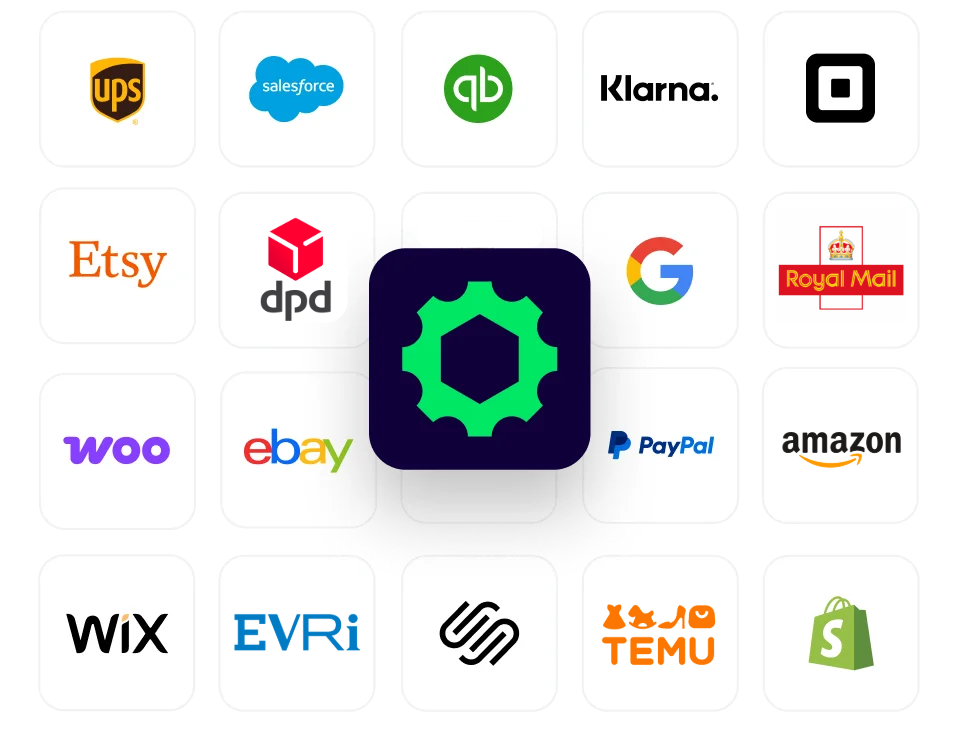
A UK ShipStation account comes with six carriers: Royal Mail, Parcelforce, Evri, DPD, UPS, and GlobalPost. You can also connect your own carrier accounts, such as DHL Express and FedEx.
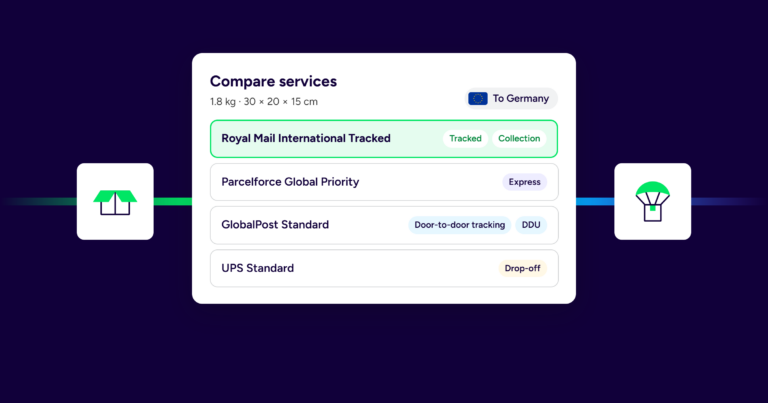
For each service you’re comparing, check four things: the weight limit, the size limit, whether it uses volumetric weight, and whether the label price includes collection or whether you drop the parcel off. For international parcels, also check who pays duty and tax. A cheap label is usually more expensive overall once collection, cover, or duty is added.
How you charge matters as much as what you charge. UK law requires you to show consumers the total price, including any charges they can’t avoid, such as delivery, wherever reasonably possible. The Competition and Markets Authority (CMA) has published guidance on price transparency explaining how it expects businesses to apply it under the Digital Markets, Competition and Consumers Act 2024. What follows summarises that guidance. It’s general information, not legal advice, so read the CMA’s guidance for the detail, particularly if your set-up is complex.
Flat fee. You charge one rate, such as £4.99, for every order. It’s simple and predictable, but you’ll undercharge on heavy or bulky parcels. A flat fee customers must pay is a mandatory delivery charge, so the CMA expects it to be included in the total price. If a customer buys several items, the CMA’s guidance gives options: show the base price alongside a total that includes delivery, or show the base price, the delivery charge, and a running total that updates as items are added.
Free delivery over a threshold. A threshold such as “free delivery over £40” encourages bigger baskets, but you’ll need to build shipping into your product prices to stay profitable. The CMA expects the full delivery fee to be included in the total price until the customer’s basket reaches the threshold. It also warns that advertising free delivery over a threshold without telling customers what delivery costs below it can be misleading.
Carrier-calculated rates. Real-time rates at checkout show customers exactly what their parcel costs to send, but they can make a basket look expensive. Where the charge varies, the CMA expects you to say that delivery charges apply and to explain how they’re calculated. Once the customer enters their address, it expects the calculated charge to appear in the running total from then on. The CMA gives an example of a retailer displaying different delivery charges for mainland Great Britain, Northern Ireland, the Isle of Man, the Channel Islands, and the Scottish Highlands and islands.
Choosing between delivery options. If customers have to pay for delivery and can choose between options, the total price at the outset should include the cheapest one. If they pick a faster option, the total should update. Paid extras such as next-day or nominated-day delivery count as optional charges. If there’s also a free collection option, the delivery charge is optional and can be shown separately, as long as it’s clear.
Build delivery into the price. You can also remove the separate delivery fee and include its cost in your product prices. In effect, that’s free delivery, and the CMA lists it as an approach that works.
VAT. Prices shown to consumers should include VAT. You can show VAT-exclusive prices to trade customers. HMRC treats delivery that’s part of a sale as a single supply of delivered goods, so the VAT on your delivery charge follows the VAT liability of the goods. A separate packing charge is standard-rated. If an order mixes items with different VAT rates, or you use a VAT retail scheme, check HMRC’s guidance for your scheme or ask your accountant how to handle the delivery charge.
The CMA also offers a free 3 Step Pricing Check at clearpricing.campaign.gov.uk to help you test your own prices.
If you sell on a marketplace, check its seller pages for its delivery and postage rules before you price, because each one sets its own. Under the CMA guidance, both the marketplace and the seller can be responsible for the total price shown, and on a marketplace, each product’s total price should include that product’s own delivery charge.
On your own website, whether it runs on Shopify, WooCommerce, or Wix, you control the set-up. Flat fees and thresholds keep things simple, and real-time rates keep things accurate. Whichever you choose, show the total price clearly and early.
International parcels add duty, taxes, and customs paperwork to the cost, and each country sets its own rules. Work those out before you quote a delivered price. Our guides to shipping from the UK to the USA, to Europe, and internationally cover them in detail.
Weigh and measure every product once, and keep the figures in your product data. Test your packaging, because a smaller box can move a parcel into a cheaper band or cut its volumetric weight. Compare services for each order rather than defaulting to one carrier. And review your free delivery threshold against your average order value, so it nudges baskets up without eating your margin.
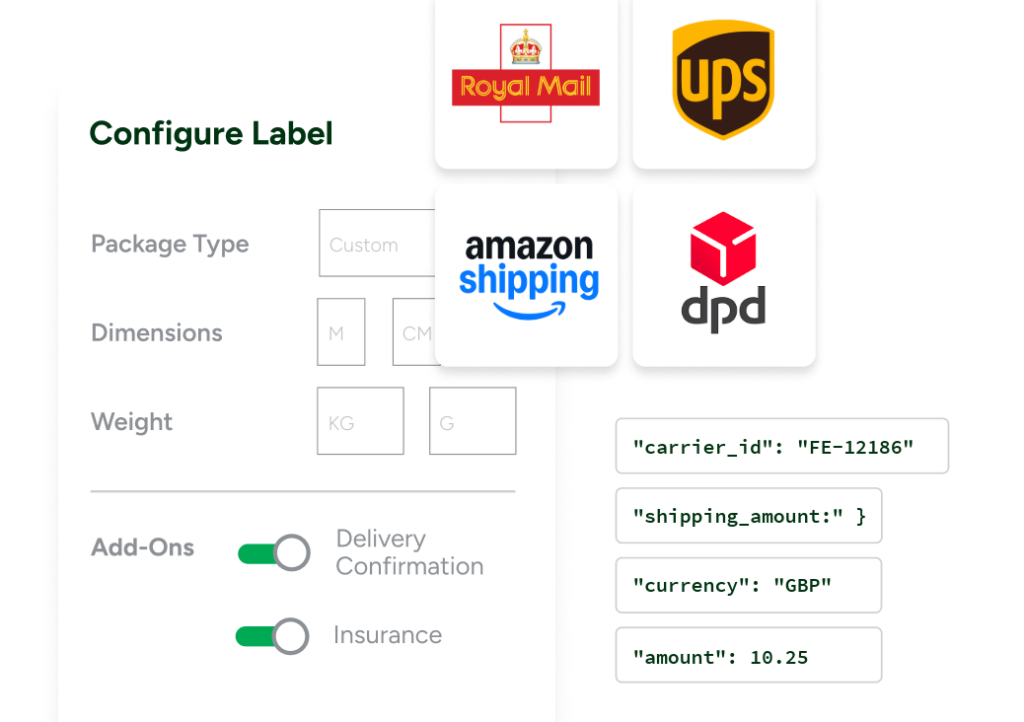
ShipStation lets you compare rates across Royal Mail, Parcelforce, Evri, DPD, UPS, and GlobalPost in one place, and automate which service each order uses. You can also connect your own carrier accounts. UK accounts pay a per-shipment fee on labels created with their own accounts rather than the included ones, invoiced monthly and varying by plan.
How ShipStation calculates rates →
Compare rates with the ShipStation calculator →
Now you know what a parcel costs to send and how to show it at checkout. For more on how UK carriers, services, and delivery options compare, browse our guides.
Keep ReadingWeight, size, destination, and speed, plus any charges a carrier adds after the label is created.
If a customer can’t buy the item without paying for delivery, the CMA expects the total price you show consumers to include it. Optional extras, such as paid next-day delivery when free collection is available, can be shown separately.
Yes. The CMA expects the full delivery fee to be included in the total price until the basket reaches the threshold, and it expects you to tell customers what delivery costs below it.
No. Some, such as UPS, bill whichever is greater of actual and dimensional weight. Evri bases its prices on weight, and Royal Mail uses size bands. For other carriers and services, check the carrier’s own rules.
Delivery that’s part of the sale takes the VAT treatment of the goods. If you sell standard-rated goods, the delivery charge is standard-rated too.