Back





























































 Shipping


The cheapest option always depends on your parcel, where it’s going, and how fast it needs to arrive. For some destinations, who pays the duty now matters as much as the postage.
This guide covers what decides the price, which services UK sellers can use, and how to compare them. We cover the two biggest markets, the USA and Europe, in separate guides, because their rules changed in 2026.
Weight and size. Carriers price by weight and size, and each service sets its own limits. In ShipStation, GlobalPost Economy takes parcels up to 2 kg with a longest side of 60 cm, while GlobalPost Standard takes parcels up to 10 kg and 100 cm. A parcel that fits a lighter, smaller service usually has more options.
Destination. Not every service covers every country, and prices vary by zone. ShipStation shows only the services that cover the destination you enter.
Speed. Express services deliver faster, but they typically cost more than standard ones.
Tracking and cover. Services differ in how far they track a parcel and what they cover if it’s lost or damaged. GlobalPost Economy tracks to the destination country and has no default cover, while Standard tracks door to door and includes default cover of up to £50.
Duties and taxes. Some services leave the recipient to pay duty and VAT on delivery. Others let you prepay. That difference changes what the customer actually pays, and in some countries, whether they accept the parcel at all.
Collection or drop-off. Royal Mail, Parcelforce, and Evri let you choose collection when you buy the label, which can save a trip. See our guides to booking a collection and finding a drop-off point.
These are the services available to UK ShipStation accounts at the time of writing. None of them is cheapest for every parcel.
Royal Mail International comes bundled with a UK ShipStation account, in Tracked, Tracked Heavier, and Tracked and Signed Heavier versions. Each comes as a drop-off or a Parcel Collect service. ShipStation submits your customs data electronically, but you still need to print and attach a CN22 or CN23 form. Use a CN23 when the declared value is above £270, and a CN22 when it’s £270 or less.
Parcelforce’s Global Priority services cover Europe and the rest of the world, in drop-off and Parcel Collect versions. They suit parcels where speed matters more than the lowest postage. Parcelforce doesn’t support multi-package shipments in ShipStation.
DPD’s international services through ShipStation include DPD Classic and DPD Air Classic. They’re drop-off services, with labels you print at home or at the shop.
GlobalPost Economy and Standard International ship to more than 200 countries, and both are DDU services, so the recipient pays duty and taxes. For the USA, GlobalPost Plus Intl is a prepaid-duties (DDP) option available to every UK account. Our guide to shipping from the UK to the USA covers it.
UPS from ShipStation also comes bundled with a UK account. It offers UPS Standard and a choice of UPS express services for international shipments, and the options differ by destination, so check which ones appear for yours when you compare rates.
If you have your own carrier accounts, you can connect them and compare them alongside the options above. That includes DHL Express, FedEx, Evri International, and DPD Ireland. UK accounts pay a per-shipment fee on labels created with your own carrier accounts rather than the included ones, invoiced monthly and varying by plan.
Your side of the border. To export from England, Wales, or Scotland, you need a GB EORI number, which is an EORI number that starts with GB. You must also find the right commodity code for your goods, and keep your commercial invoices and customs paperwork. If you’re sending goods to a country where they qualify for reduced or zero duty, you may need proof of origin.
The destination’s side. Each country sets its own duty and tax rules, including the value below which parcels were once exempt. Both the USA and the EU removed theirs in recent months, and others can change just as quickly. Check the destination country’s rules before you quote a delivered price.
Who pays at the door. With DDU, the recipient pays duty and taxes on arrival. With DDP, you prepay them, so nothing is owed on delivery. Availability varies by carrier, service, and destination.
Your customs data. Give every parcel an accurate description, value, country of origin, and commodity code. Vague descriptions cause held parcels.
Weigh and measure the parcel first, because size and weight rule services in or out.
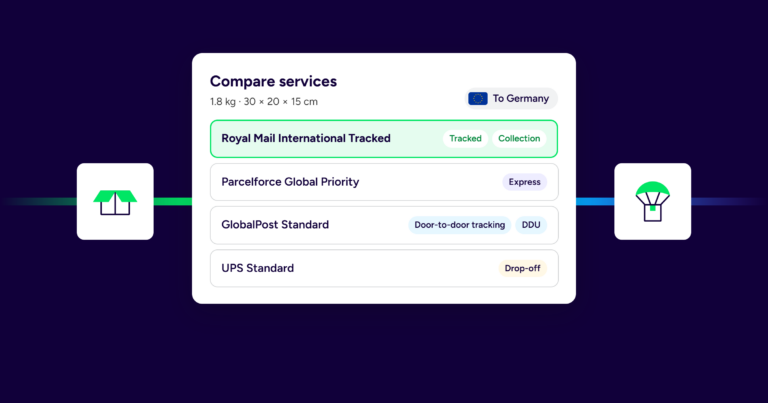
Enter the destination. ShipStation shows the services that cover it, so you compare only real options.
Decide what matters. If speed matters, compare express services. If tracking and cover matter, check what each service includes.
Add the duty and taxes. Compare like for like, with a DDP price next to a DDP price and a DDU price next to a DDU price. A DDU price always looks cheaper, but it leaves out what your customer pays at the door.
Re-check regularly. Rates, services, and customs rules move, so don’t rely on last season’s numbers.
Compare rates with the ShipStation calculator →
ShipStation shows the services available to your UK account in one place, generates customs documentation automatically, and prints labels in batches. You can compare rates across Royal Mail, Parcelforce, DPD, GlobalPost, and UPS from one login, and connect your own accounts for carriers such as DHL Express and FedEx.
International shipping from the UK with ShipStation →
The postage is only part of the bill. Compare the services that cover your destination, add the duty, and re-check when the rules move. ShipStation shows every available service for a parcel in one place.
Start a Free TrialIt depends on the parcel’s weight and size, the destination, the speed you need, and who pays the duty. Compare services for your own parcel rather than relying on a general answer.
Yes, for parcels leaving the UK. With Royal Mail through ShipStation, that means a printed CN22 for declared values of £270 or less, and a CN23 above that.
To export from England, Wales, or Scotland, you need an EORI number that starts with GB.
DDU means the recipient pays duty and taxes on delivery. DDP means you prepay them. Which one you can use depends on the carrier and the destination.
No. Each country sets its own duty and tax rules, and the USA and the EU both changed theirs in 2026. Read our guides to shipping from the UK to the USA and to Europe, and check the destination country’s rules for anywhere else.
Yes. You can connect your own accounts and compare them with the included carriers. UK accounts pay a per-shipment fee on labels created with their own accounts.