Back
Back









































 Shipping Basics


This blog was contributed by our partner, BlueSwitch. BlueSwitch provides a suite of services for ecommerce merchants, including website development, marketing, and branding.

It seems these days that everybody and his brother has an ecommerce store. And you’d be hard-pressed to find a brick-and-mortar retailer who doesn’t also sell their products online.
To put it bluntly, the ecommerce space is crowded. Remarkably crowded. But it’s also remarkably lucrative: According to Statista, ecommerce sales are expected to reach $2.7 trillion in 2018 and nearly $4.5 trillion in 2021.
However, you can’t jump into the online retail arena haphazardly. And there’s a crucial aspect of owning the ecommerce space that many merchants forget: branding. But branding goes beyond a name and a logo. Your brand is your story, your personality, your values, your mission. It represents your commitment to shoppers and your dedication to the customer experience.
It doesn’t matter if your product is heads and tails above anything on the market. If you haven’t invested in your brand identity, you simply won’t succeed. It’s as simple as that.
A strong brand is the difference between flourishing and failing. To make sure your store succeeds, following the ecommerce branding strategies below.
Your entire brand and its communications should center around your target audience. These are the shoppers who will be most interested in and likely to buy your products. But before you can do that, you have to know who your audience is.
Start by building buyer personas. Buyer personas are fictional representations of your ideal customers. To build buyer personas, you need to conduct market research and gather data about specific characteristics of your audience. These include:
In their 2016 Benchmark Study Understanding B2B Buyers, customer intelligence software provider Cintell analyzed the impact of buyer personas. It found that 71% of companies who exceed their revenue and lead goals create formal personas. On the flipside, 26% of organizations that fall short of their objectives don’t build personas. Clearly, defining your audience is among the most important ecommerce branding strategies.
What’s your brand story? Why should shoppers care about your business? And furthermore, why should they purchase from you? Everyone loves to hear stories about how a company started with an idea sketched on a cocktail napkin. Or how it all began with your Great Grandma Mildred cooking fudge in her kitchen.
If your story isn’t actually all that compelling, make it compelling. A good brand story helps build connections with shoppers. A dull (or nonexistent) story makes you just another face in the ecommerce crowd.
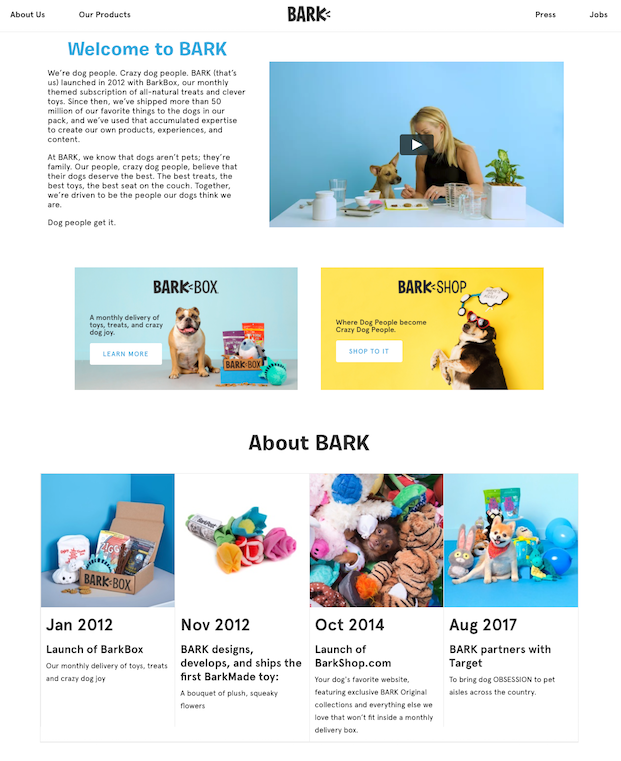
Your brand story, mission statement, and values should appeal to your target market’s emotions. Take a page from the playbook of BARK, a retailer of dog treats and toys. It has its story front and center on its homepage:
A unique selling proposition can also differentiate your products from those of your competitors. Do you use all-organic ingredients or handmade materials? Do you donate a portion of your sales to a humanitarian cause related to your business? Tell shoppers what makes your brand different and why they should buy from you instead of your competition.
Want loyal customers? Then you need to present yourself as a helpful partner and not just another store only interested in driving sales. Of course your end goal is to bring in revenue. But that doesn’t mean your website should be focused entirely on getting consumers to place orders.
Offering helpful, relevant content is one of the most effective ecommerce branding strategies. It proves you care about shoppers and their experience. “Relevancy” is critical. Use your buyer personas to create content that shoppers actually want and that isn’t just taking up space on your site. For example, customers who buy high-end technology will probably enjoy in-depth blogs about upcoming trends. Busy parents looking for toys will appreciate reading shorter blog posts on how to maximize time with their children.
Understanding what type of content will appeal to your target audience is an ongoing process. Regularly consult your website analytics and social media reports to see what type of content shoppers enjoy the most.
At the end of the day, the driving force behind ecommerce branding strategies is the customer experience. Be confident your audience associates delight and satisfaction with every element of your brand.