































Small BusinessesStart small, think big. Elevate your small-business shipping today.
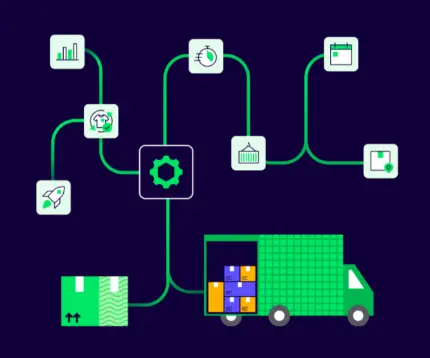
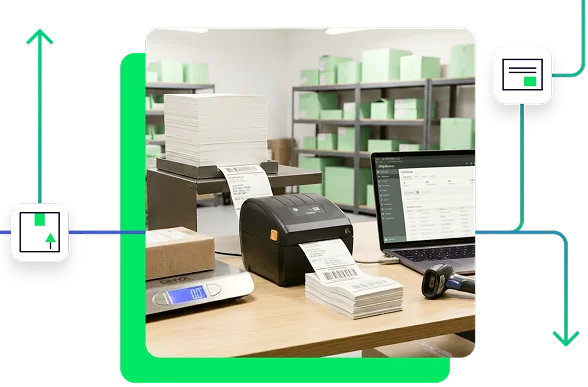
Start Shipping in MinutesStart shipping instantly with a simple setup. Buy and print labels in minutes with no training needed and no unnecessary steps.
Automate and ScaleSave time with rules that batch, route, and print labels automatically so your shipping keeps up as orders grow.
Save on Every ShipmentAccess exclusive 80% – 90% discounts from every major carrier and cut costs on every label, no matter where you ship.
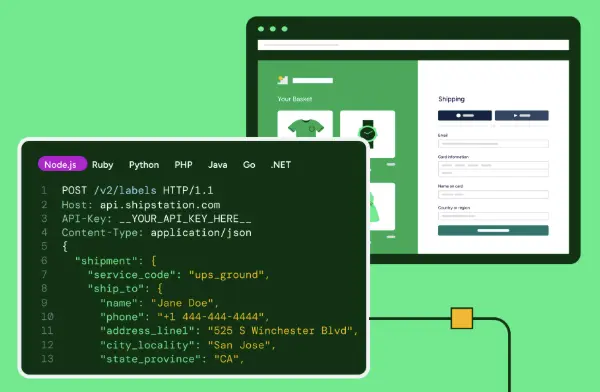
Connect and CustomizePlug into hundreds of stores, marketplaces, and carriers, or extend ShipStation with custom API integrations built for your business.
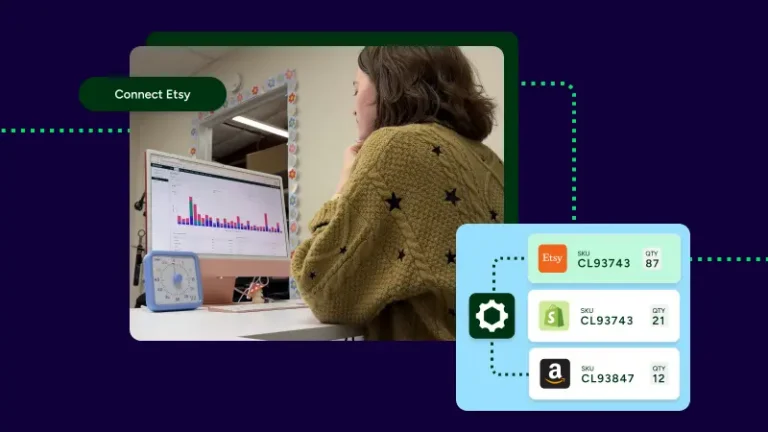
Manage Everything in One PlaceManage shipping, inventory, warehouse, tracking, and returns for all your stores and marketplaces in one simple platform.
Simplify ReturnsManage returns in one platform with prepaid labels and self-serve features that keep the process fast and frustration-free.
Get Up and Running QuicklyOur implementation team guides you through a step-by-step process to help you streamline workflows and keep costs minimized.
Mid-size and GrowingShip smarter, grow faster. Scale your fulfillment with ease.
Save on Shipping as you ScaleAutomate rate shopping across 200+ carriers, bring your own carrier accounts, and unlock deep volume discounts that grow with you.
Smarter Shipping IntelligenceTurn shipping into your competitive advantage with intelligence that improves with every order.
Centralize Omnichannel FulfillmentManage orders, shipping, inventory, warehouse operations, tracking, returns, and analytics across online stores and marketplaces with one platform.
Automate Order ManagementCombine AI intelligence with rule-based workflows to speed up fulfillment, streamline operations, and eliminate bottlenecks
Scale With our APIsExtend your setup using our developer-friendly API for custom automated workflows and insights.
Start with Guided OnboardingOur experts walk you through setup, training, and workflows so your team feels confident and ready to ship quickly.
EnterpriseGlobal scale, local precision. Master shipping at every level.
Lower Shipping Costs at Global ScaleReduce global shipping expenses with real-time rate shopping and discounted carrier rates, helping your enterprise control costs and ship efficiently at scale.
International Shipping Made SimpleEasily manage customs forms, duties, taxes, and tracking while accessing global carrier options from one platform built for cross-border shipping.
Fulfillment APIsCustomize workflows at scale with APIs for consolidating orders across channels, comparing shipping rates, validating addresses, tracking, analytics, and more.
Multi-Location FulfillmentManage inventory, orders, and shipping across multiple warehouses and stores with one platform built for multi-location fulfillment.
Advanced Shipping IntelligenceTurn shipping into your competitive advantage with intelligence that improves with every order.
Dedicated Guidance and SupportCount on 24x7 support plus dedicated onboarding guidance so your enterprise shipping runs reliably from day one and beyond.
How Guardian Sports Used Automated Returns to Scale After Going Viral with the NFL
After the NFL adopted their concussion-reducing Guardian Cap, this Atlanta-based sports safety company saw orders explode to 400 per day—and the team’s manual processes couldn’t keep up.
BlogGet the latest on carriers, shipping rates, Ecommerce trends, and emerging fulfillment technologies
Multi-Currency Invoicing for ShippingLearn how multi-currency invoicing for shipping simplifies global invoices, reduces errors, and helps you bill customers...
Shipping Delivery Exception Alerts GuideShipping delivery exception alerts explained: learn common causes, how to prevent delays, and what to check when a packa...
DHL International Shipping Made SimpleDHL international shipping with ShipStation helps you create labels, manage customs, and ship globally with ease. Learn ...
The conclusion is clear: AI is already influencing demand, competition, and delivery performance—and retailers that fail to adapt risk being excluded from AI-led shopping journeys altogether.
The Brands That Stopped Hiring for Peak Season: What They Did Instead
Most sellers treat peak season staffing as the cost of growth: volume spikes, so headcount follows. But two operators at Innovation Delivered 2026 proved otherwise. Ned Woodward of Spiceology hasn't made a single seasonal hire in three years despite 30 to 40% order jumps each peak season, and Maïré BAVARDAY-ROSA of ecomspaces has scaled teams 6x without adding a single person. Here's how they broke the link between volume and headcount.
At Innovation Delivered 2026, on the panel “Scale Your Operations Without Scaling Your Team,” two operators explained how they did the opposite. Ned Woodward, director of logistics and fulfillment at Spiceology, said his team hasn’t made a single seasonal hire in three years, despite absorbing a 30 to 40% jump in order volume each peak season. Maïré BAVARDAY-ROSA, CEO of ecomspaces, said the same team that ships 500 orders a day can scale to 3,000 without adding headcount.
Growth doesn’t have to mean growing headcount. Here’s how they rethought peak season staffing instead.
Why peak-season hiring became the default fix
During the panel, moderator Lexi Kenneally, Senior Project Manager of ShipStation Global, shared a stat that explains why so many sellers keep hiring: 67% of ecommerce operators are running a shipping workflow built for a previous stage of growth. Most built it years ago, when their business shipped a fraction of today’s volume, and never rebuilt it as things scaled. The workflow doesn’t break outright. It just quietly turns into the reason you need more people every time volume spikes.
67%
of ecommerce operators say their shipping workflow was built for an earlier stage.
That gap is exactly what pushes so many teams back into peak season staffing mode instead of fixing the workflow underneath it. At Spiceology, peak season used to mean bringing on seasonal help every year, then managing the fallout once volume dropped and the team had to shrink back down.
“Every time peak season hit and the holidays came around, we were looking to hire 7 to 10 people, bring them on, train them up, and deal with all the staffing issues through the holidays to handle that volume and meet customer demand.”
Ned Woodward, Director of Logistics & Fulfillment, Spiceology
BAVARDAY-ROSA sees the same pattern from the outside, working with founders who build their own fulfillment operations. For her, the obstacle isn’t technology. It’s mindset: founders, she said, “don’t see building systems as an investment” until volume forces the issue.
Both operators had to get comfortable trusting a system before they’d let go of the old peak season staffing routine.
What they built instead of a bigger team
At Spiceology, the fix started with automating a single task: labeling. One customer required specific ship-from locations and third-party billing codes on every order, and Woodward’s team was entering that information by hand. Woodward said, “Before we automated this, we were spending three or four hours a day on these efforts. Once we automated that piece and tested it through the system, we had an immediate 84% time savings on just that specific customer.”
He pushed the data straight from Spiceology’s ERP into ShipStation’s order management using automation rules, so the system filled in the correct ship-from location and billing code on its own. Before it ever touched a live order, he tested the setup in a sandbox environment and watched for what broke.
84%
time savings on one automated task at Spiceology
At ecomspaces, BAVARDAY-ROSA builds similar guardrails for the brands she onboards, most of which arrive with no systems in place at all. She starts with carrier mapping: routing each order to the carrier a customer picked, or the cheapest option, without anyone checking by hand. From there, she builds automations for anything that repeats. She said, “If they want to use special packaging for a specific SKU, we create an automation for that. Look at the SKU, create a trigger. When this SKU is in the order, use extra packaging, or add something specific.”
Both started the same way: pick one decision, automate it, then move to the next.
Three peak seasons, one team
This isn’t a one-off for either operator. It’s the same pattern showing up in both operations, just at a different scale, as the numbers below show.
“The same number of people I would use to ship 500 orders, I was able to scale to 3,000 orders a day without hiring more people. That’s a huge saving.”
Maïré BAVARDAY-ROSA
For Woodward, the payoff went beyond the budget. Skipping the seasonal hiring cycle also meant skipping the training curve and the added management load a bigger, temporary team brings.
“It’s been not only a cost savings, but a lot less stress for our management team,” he said, “not having to manage additional staff, just taking care of the team we have.”
Here’s what swapping peak season staffing for automation actually looks like in the numbers:
Spiceology: 3 consecutive peak seasons, 0 seasonal hires, 30–40% more orders absorbed each time
ecomspaces: 500 → 3,000 orders a day, same headcount, 6x the volume
Where to start before your next peak season
Neither operator solves peak season staffing overnight, and both offered the same core advice: start now, before volume forces your hand.
Test before you trust. Before any automation touches a live order, Woodward runs it in a sandbox first: “We were able to test in a sandbox environment in our ERP, push some of that automation into ShipStation, and watch what broke so we could go back and fix it on the front end.”
Write it down before you build it. BAVARDAY-ROSA’s rule: “Write down all your processes, write down everything in your business…Keep it simple. Know what you’re doing right now, and know what you want it to look like.”
And don’t wait for volume to force the decision.
“The longer you wait, the harder it’s going to be, and it’s going to slow your growth.”
Maïré BAVARDAY-ROSA
That’s the takeaway from the session: peak-season staffing isn’t the fix—automated decision-making is.