Small BusinessesStart small, think big. Elevate your small-business shipping today.
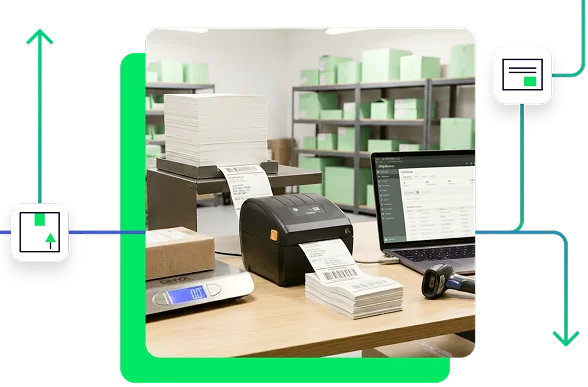
Start Shipping in MinutesStart shipping instantly with a simple setup. Buy and print labels in minutes with no training needed and no unnecessary steps.
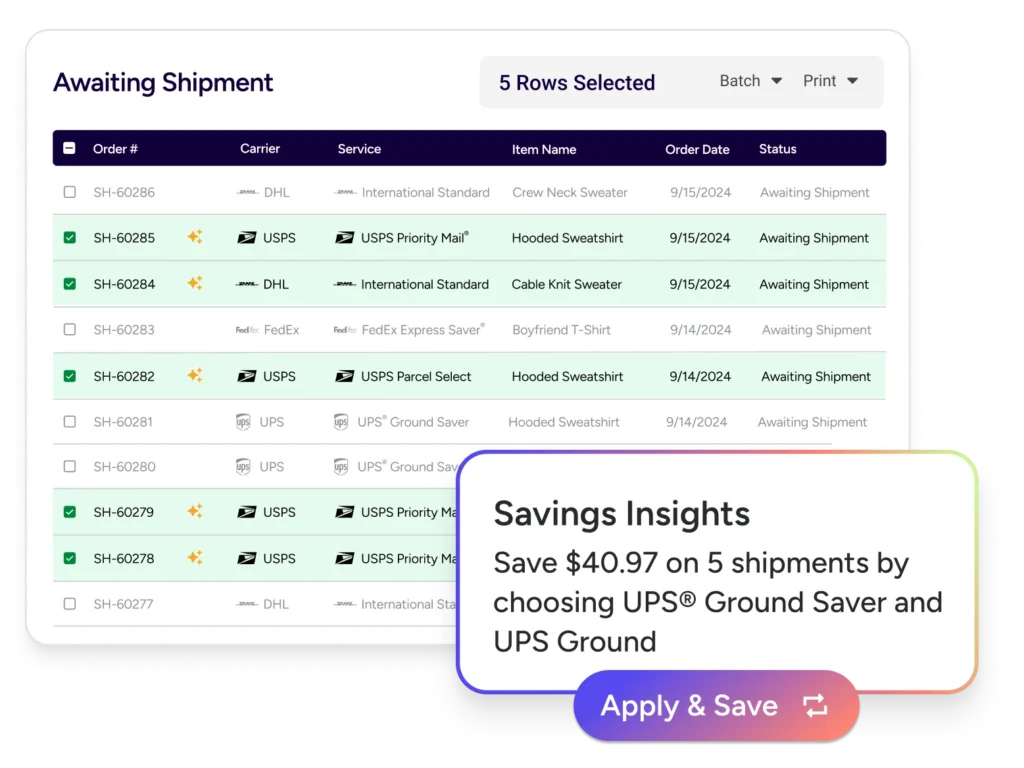
Automate and ScaleSave time with rules that batch, route, and print labels automatically so your shipping keeps up as orders grow.
Save on Every ShipmentAccess exclusive 80% – 90% discounts from every major carrier and cut costs on every label, no matter where you ship.
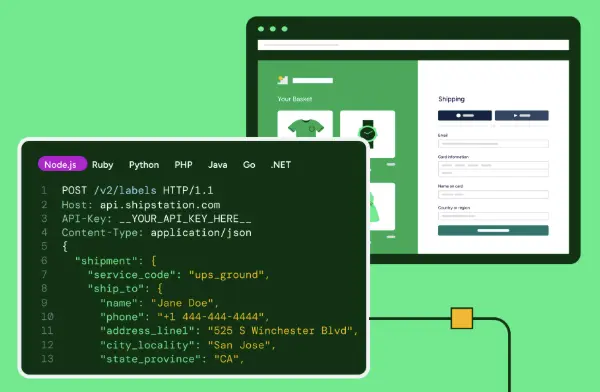
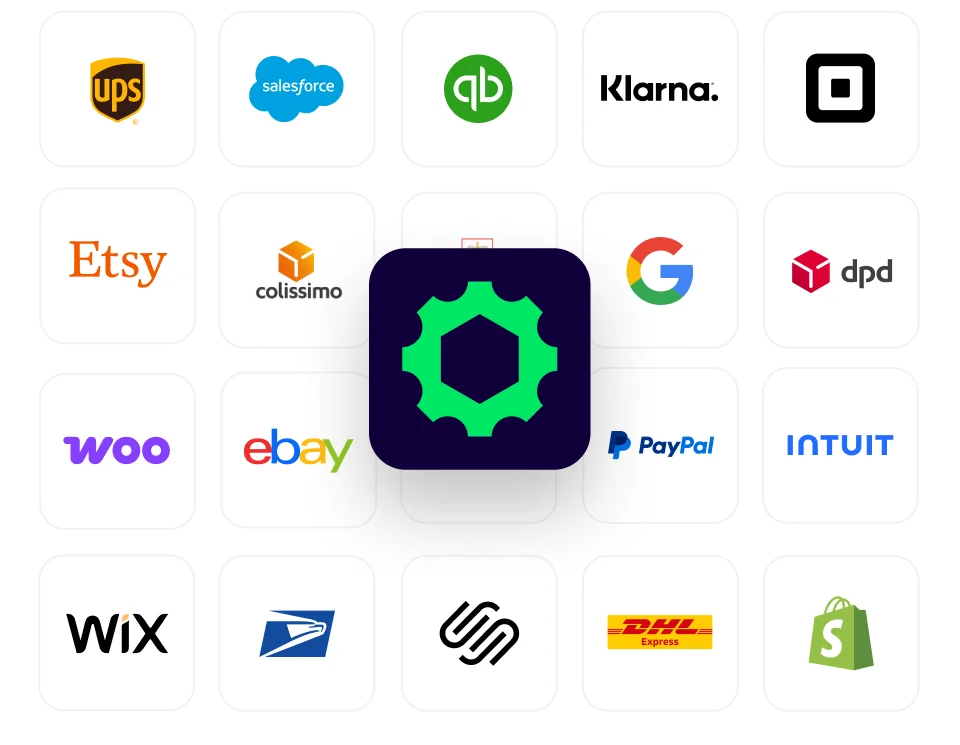
Connect and CustomizePlug into hundreds of stores, marketplaces, and carriers, or extend ShipStation with custom API integrations built for your business.
Manage Everything in One PlaceManage shipping, inventory, warehouse, tracking, and returns for all your stores and marketplaces in one simple platform.
Simplify ReturnsManage returns in one platform with prepaid labels and self-serve features that keep the process fast and frustration-free.
Get Up and Running QuicklyOur implementation team guides you through a step-by-step process to help you streamline workflows and keep costs minimized.
Mid-size and GrowingShip smarter, grow faster. Scale your fulfillment with ease.
Save on Shipping as you ScaleAutomate rate shopping across 200+ carriers, bring your own carrier accounts, and unlock deep volume discounts that grow with you.
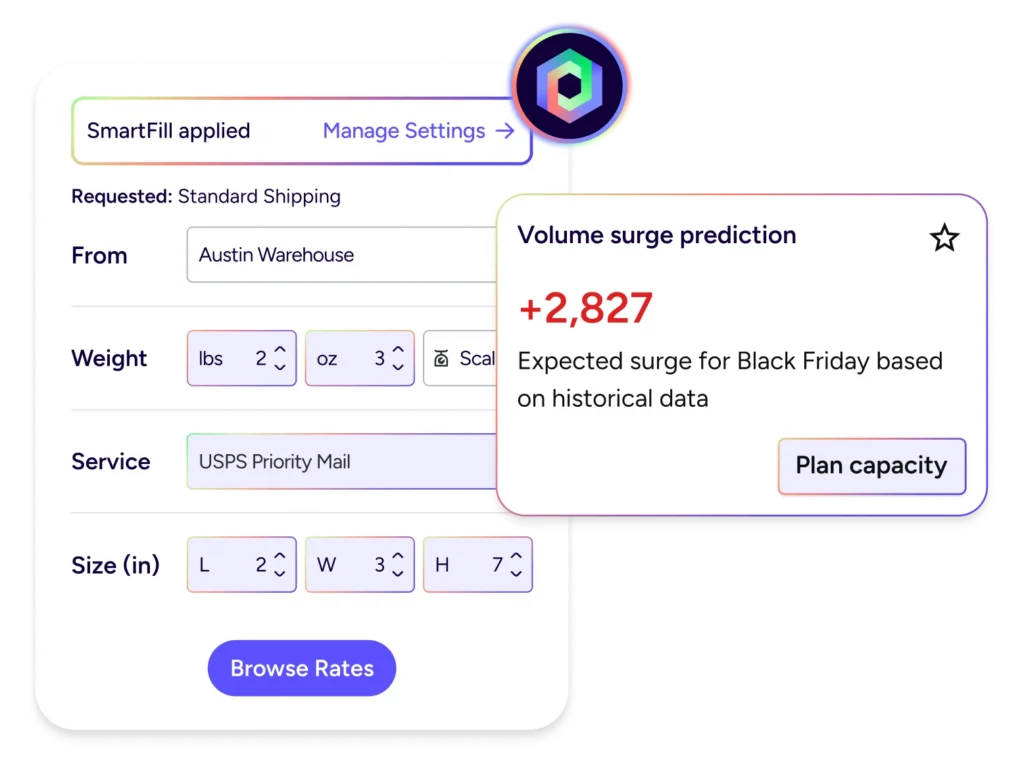
Smarter Shipping IntelligenceTurn shipping into your competitive advantage with intelligence that improves with every order.
Centralize Omnichannel FulfillmentManage orders, shipping, inventory, warehouse operations, tracking, returns, and analytics across online stores and marketplaces with one platform.
Automate Order ManagementCombine AI intelligence with rule-based workflows to speed up fulfillment, streamline operations, and eliminate bottlenecks
Scale With our APIsExtend your setup using our developer-friendly API for custom automated workflows and insights.
Start with Guided OnboardingOur experts walk you through setup, training, and workflows so your team feels confident and ready to ship quickly.
EnterpriseGlobal scale, local precision. Master shipping at every level.
Lower Shipping Costs at Global ScaleReduce global shipping expenses with real-time rate shopping and discounted carrier rates, helping your enterprise control costs and ship efficiently at scale.
International Shipping Made SimpleEasily manage customs forms, duties, taxes, and tracking while accessing global carrier options from one platform built for cross-border shipping.
Fulfillment APIsCustomize workflows at scale with APIs for consolidating orders across channels, comparing shipping rates, validating addresses, tracking, analytics, and more.
Multi-Location FulfillmentManage inventory, orders, and shipping across multiple warehouses and stores with one platform built for multi-location fulfillment.
Advanced Shipping IntelligenceTurn shipping into your competitive advantage with intelligence that improves with every order.
Dedicated Guidance and SupportCount on 24x7 support plus dedicated onboarding guidance so your enterprise shipping runs reliably from day one and beyond.
How Guardian Sports Used Automated Returns to Scale After Going Viral with the NFL
After the NFL adopted their concussion-reducing Guardian Cap, this Atlanta-based sports safety company saw orders explode to 400 per day—and the team’s manual processes couldn’t keep up.
Amazon MCF with ShipStation, SimplifiedAmazon Multi-Channel Fulfillment with ShipStation helps you connect orders, tracking, and fulfillment across sales chann...
Shopify Shipping and Fulfillment GuideLearn how ShipStation for Shopify shipping and fulfillment helps automate orders, print labels, compare rates, and simpl...
ShipStation for Amazon FBA and FBM OrdersShipStation for Amazon FBA and FBM orders helps you manage fulfillment, products, and customer updates in one place. Lea...
The conclusion is clear: AI is already influencing demand, competition, and delivery performance—and retailers that fail to adapt risk being excluded from AI-led shopping journeys altogether.
The conclusion is clear: AI is already influencing demand, competition, and delivery performance—and retailers that fail to adapt risk being excluded from AI-led shopping journeys altogether.
The conclusion is clear: AI is already influencing demand, competition, and delivery performance—and retailers that fail to adapt risk being excluded from AI-led shopping journeys altogether.
The Delivery Shift: How Intelligence is Becoming the Decision Layer of Delivery
The Delivery Shift: How Intelligence is Becoming the Decision Layer of Delivery
Discover how AI and automation are becoming the decision-making engine behind faster, smarter, more profitable fulfillment—and how leading ecommerce businesses are using real-time intelligence, predictive insights, and connected fulfillment to stop reacting to problems and start staying ahead of them.
Introduction
Shipping used to sit in the background. It was operational. Necessary. Often stressful. But rarely strategic. That has changed.
Order volume grows. Channels multiply. Carrier rates fluctuate. Competition intensifies. Inventory planning turns reactive. Demand patterns move faster than forecasting cycles. Support tickets spike. Deliveries slip. And conditions are always changing.
Static systems struggle in a dynamic environment. What once felt manageable starts to feel fragile.
The instinct is to add more people, tools, or integrations. But stacking effort on top of complexity does not remove the intricacy. It just hides it for a while.
The real issue is structural. Most fulfillment operations were built to execute shipments—not to learn from them. They process orders efficiently, but they do not continuously optimize decisions. They follow rules, but they do not adapt when conditions change.
Today, shipping and delivery affects margin, speed, customer loyalty, and brand perception. It shapes reviews. It drives repeat purchases.
Shipping and delivery can quietly fuel growth—or quietly erode it.
What modern commerce requires is not more oversight. It requires an intelligence layer—one that connects data across systems, applies automation in real time, and improves with every shipment.
The gap between delivery capability and consumer expectations
Seven in ten retailers expect online sales growth to strengthen over the next year. But that hinges on their ability to respond to how shoppers discover, compare, and shortlist products today.
When retailers were asked which factors are most likely to impact business performance in 2026, adopting AI and new technologies came out on top (Ecommerce Delivery Benchmark Report 2026).
Factors most likely to impact business performance in 2026
Retailers were asked which factors are most likely to impact their business performance
A large majority of ecommerce businesses plan to invest more in AI agents and assistants over the next 12 to 24 months.
This highlights the growing influence of AI on the shopper journey and the scale of change retailers must manage. With operational and fulfillment costs rising faster than revenue growth for many retailers, efficiency becomes a survival skill, not a nice-to-have. Those who fail to evolve risk falling behind smarter, more data-driven competition.
Plans for AI agent integration by retailer size
How retailers of different sizes are approaching AI agent partnerships
Large ($625m+)Mid-size ($125m–$624m)Small (under $125m)
On top of all this, shoppers are scrutinizing delivery value more closely. Demand for best-in-class delivery is rising rapidly amid easy comparison and abundant choice.
Low-cost, fast, and flexible delivery is now a baseline requirement.
Consumers consider delivery cost the most important aspect of the online delivery experience. More than half expect a standard order to arrive within two days.
What consumers value most in delivery
Top delivery priorities ranked by consumers, 2023–2026
Cost of deliverySpeed of deliveryDelivery convenienceFlexible returnsDelivery visibilityGreen delivery
Consumers increasingly expect delivery options that fit busy lifestyles. And the up-front delivery promise is expected.
58%
of consumers abandon their carts if no specific delivery date is provided.
Source: Statista Consumer Insights
Delivery can be a powerful differentiator, but only when done exceptionally well. This is the shift redefining fulfillment. The following are some of the key ways intelligence is informing and executing shipping and delivery decisions for the leading retailers today.
Automation is replacing repetition
As order volume grows, small tasks multiply. Adding SKUs. Selecting carriers. Assigning services. Choosing package types. Processing returns. It adds up.
These tasks seem minor individually, but multiplied across thousands of orders, they slow teams down and open the door to risk.
Many fulfillment tasks follow predictable steps—orders are received, routed to the right warehouse, picked, packed, and prepared for shipment. When these steps rely on manual decision-making and execution at every stage, delays and mistakes become more likely.
Automation transforms that dynamic by introducing rules and workflows that guide orders through the process without extra work or human intervention. Efficiency and accuracy become part of the process rather than something teams must constantly monitor and control.
At a practical level, automation that triggers actions based on predefined conditions helps streamline dozens of common shipping tasks, including:
Address validation that verifies shipping addresses before labels are created, helping prevent delays and failures.
Batch label printing that generates labels for multiple orders at once, getting orders out the door with fewer clicks.
Alerts that notify teams when something unusual happens with an order.
Rate shopping that automatically selects the best shipping option based on predefined logic rather than manual rate browsing, ensuring merchants consistently secure the lowest cost or best-fit service at scale.
These capabilities are essential, but true intelligence goes deeper. Next-level intelligence starts when systems learn from past shipments and apply logic automatically.
Autofill is one example. When the system recognizes a product—or a combination of products—from a previous shipment, it automatically fills in the weight and dimensions. No need to re-enter the same details repeatedly. At scale, it removes thousands of clicks, eliminates mistakes, and speeds up label creation.
Using rule-based if-then logic, routine decisions are handled through structured automation rules that assign carriers, services, and packaging without intervention.
Rules can be configured easily and implemented instantly. Templates provide users with out-of-the-box automation that gives them a starting point for optimizing their operations, while automated scheduling lets users determine when rules run—not just what they do.
Less manual work. Less room for costly errors.
The result is simple:
Workflows scale without adding headcount.
Operations stay fast and accurate, even as volume spikes.
High-volume shipping becomes predictable and controlled.
Teams focus on exceptions, not repetition.
This is where insights turn into action.
Instead of showing teams what to do, intelligence does it for them—quietly, consistently, and at scale.
This is taken further with the ability to find answers faster with AI. Teams can ask questions or describe their shipping needs in plain language, and the system performs the tasks—from resolving issues to building complex workflows instantly without manual configuration.
Automation is not about removing people. It is about reserving human attention for what actually requires judgment.
Customer Story
Struggling with manual shipping that curbed growth, Go For Zero implemented automated rules that simplified label creation, applied preset shipment settings, and selected the correct packaging for each order. Automation allowed the retailer to cut fulfillment time by 40% and manage double the order volume without more headcount.
In the past, businesses usually made shipping decisions through manual processes, static rules, or simple carrier relationships. That approach assumed stability—consistent rates, consistent performance, consistent lanes.
These methods worked at a smaller scale, but began to break down as order volume increased.
To choose which carrier service to use, for example, some teams looked at the destination, package weight, and delivery deadline. That relied heavily on human judgment and experience, which meant choices could vary depending on who handled the order.
Some simply appointed a single primary carrier and used it for most shipments. This made things easy, but ignored better or cheaper options from other carriers. Others reviewed historical shipping data monthly or quarterly to adjust their carrier strategy. However, these insights were delayed and required manual analysis, making it difficult to respond quickly to changing conditions.
In reality, carrier performance varies by geography and time. Costs shift. Service levels change. A standard or static carrier preference may be convenient, but it rarely remains optimal.
A modern intelligence system automates and optimizes these decisions by shifting routine shipping choices from manual judgment to system-driven logic.
By analyzing large amounts of order data in real time, the system determines the best course of action. Decisions happen immediately as orders enter the system.
Several factors are considered during that decision process, including:
Destination and delivery distance
Package weight and dimensions
Historical carrier performance
Required delivery speed
Current carrier rates
Every label is optimized using live data. When a label is created, the system instantly compares carriers and evaluates speed, cost, and delivery requirements. It then selects the optimal shipping option for that specific shipment. It does this for every package, every time.
This is not static logic. It's dynamic and responsive. It treats each shipment as a data point—not as an afterthought.
Auto-routing reinforces this logic. When inventory is distributed across multiple warehouses, a smart platform chooses the fulfillment location closest to the customer, reducing both transit time and shipping costs. That decision, too, can be automated.
Together, these capabilities turn default shipping decisions into intelligent ones. Each shipment is treated individually. Each label reflects the best available option at that moment.
Real-time decisioning is no longer a luxury. It is quickly becoming the standard for competitive fulfillment.
Customer Story
Before automated rate shopping, Spiceology's team spent 12 hours per week manually comparing rates of each carrier for hundreds of orders from multiple channels. With rate shopping, the team now accesses all rates in one system that automatically identifies the most cost-effective option for each shipment.
Traditional reporting tells you what happened. Modern intelligence tells you what is about to happen. There is a big difference.
With fragmented reporting—carrier performance in one system, sales trends in another, warehouse metrics somewhere else—its impossible to see the full picture.
There's also the delay in visibility caused by time-intensive manual reporting. Teams typically spend 2–3 days building a single complex BI report, while juggling other competing priorities. By the time trends become apparent, they are already affecting customers.
An AI-driven platform connects signals. And retailers gain context.
Using data modeling and machine learning to report on sales trends, carrier performance, and shipping costs, fulfillment teams gain a unified view across channels and orders in real time.
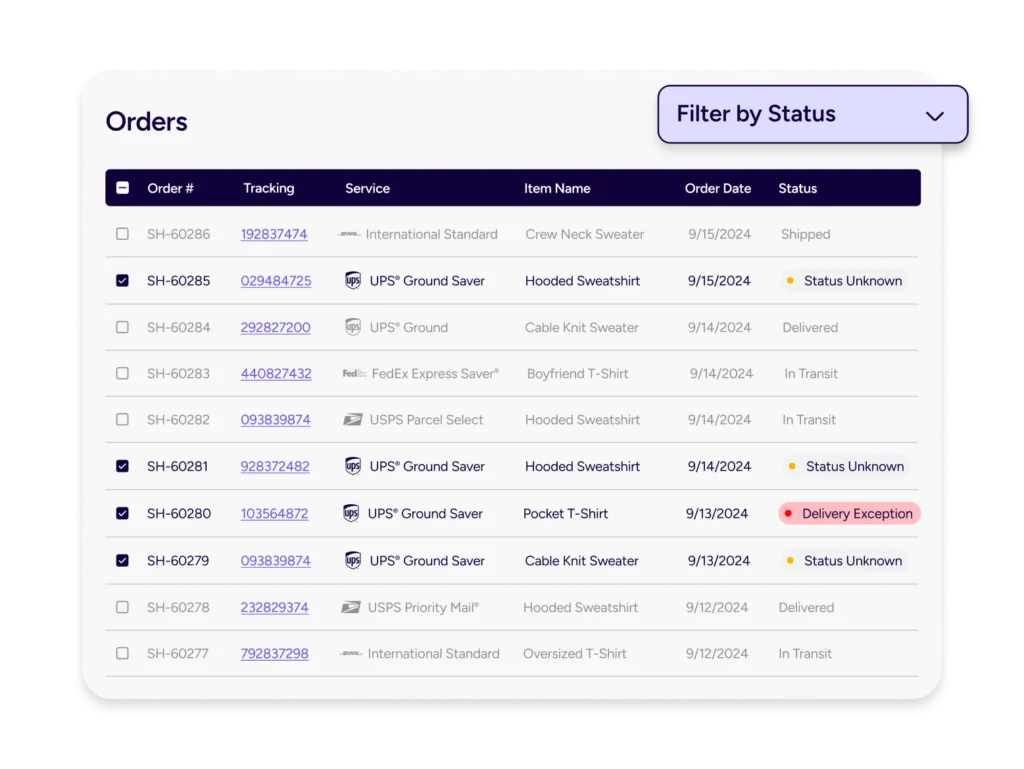
Delivery performance intelligence highlights delays, risks, and exceptions early—before they evolve into recurring issues or customers even notice. Estimated delivery dates become informed projections rather than rough assumptions. Patterns in late shipments can be addressed before support tickets surge.
This changes the rhythm of operations from troubleshooting to prevention. Even customer support teams benefit from this. 30–40% of all customer-service contacts are “Where Is My Order?” inquiries.
Preventing issues ahead of time reduces unnecessary support costs required to address them.
Meanwhile, role-based dashboards provide curated analytics views tailored to different users and teams, allowing each role to instantly access the most relevant shipping performance metrics without sifting through generic data.
When data is connected and continuously analyzed, fulfillment becomes less reactive. Instead of asking, “What went wrong?” teams begin asking, “What is likely to go wrong—and how do we fix it now?”
And when the system is built on massive datasets of shipment outcomes, insights become more granular and accurate over time. Each shipment strengthens the model. Each data point refines the next decision.
Analytics stops being retrospective reporting. It becomes forward-looking guidance.
Inventory and fulfillment operate as one system
Shipping performance is tightly linked to inventory accuracy. Yet in many organizations, inventory planning and fulfillment execution remain disconnected.
Inventory management and fulfillment operations often live in separate tools. An inventory system tracks stock levels and purchasing, while shipping software focuses on printing labels and sending packages.
These disjointed systems force teams to rely on manual updates or spreadsheets to coordinate.
The result is familiar: delays, errors, overselling, stockouts, rush replenishment orders, and excess carrying costs.
Delays
Errors
Excess carrying cost
Overselling
Rush replenishment orders
Intelligence bridges that gap by combining inventory and fulfillment decisions into a single system.
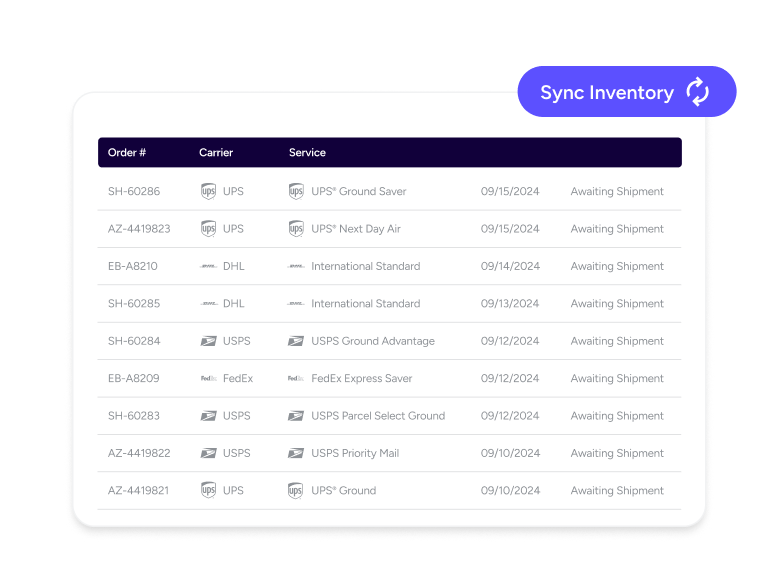
One key way this works is through inventory synchronization. Intelligence automatically keeps product quantities up to date across sales channels as orders are placed and fulfilled. When inventory changes in one system, those updates are reflected across the rest of the systems. This prevents situations where an item appears available on a store or marketplace but is already sold out in the warehouse.
By keeping stock levels up to date and aligned across platforms, automation removes the need for employees to check inventory systems before shipping each order. The system already knows which products are available and where they are located, enabling labels and fulfillment workflows to proceed immediately.
Businesses prevent overselling across multiple sales channels, avoid order cancellations caused by stock discrepancies, and move orders through fulfillment without manual inventory checks. An intelligent platform also analyzes stock levels and sales trends to forecast demand and automate reorders by creating purchase orders for vendors before inventory runs out.
But intelligence goes well beyond synchronization and forecasting, extending into other areas—from the moment a new product appears in an order to the moment it’s picked from the shelf.
Smart product creation ensures new items from connected stores are recognized instantly. If the SKU does not already exist, the system automatically creates a new product record and pulls in essential metadata from the order. From there, picking automation organizes orders into efficient batches and prepares work for the floor. And with pick-to-light technology guiding warehouse staff directly to the right items, teams can process orders quickly and accurately.
Together, these capabilities create a fulfillment flow that is connected, responsive, and built for scale.
By unifying inventory data, automation, and fulfillment workflows, teams have room to plan.
Instead of reacting to low-stock alerts at the last minute, they anticipate. Purchasing decisions become data-informed rather than reactive. Inventory becomes more predictable, and fulfillment remains steady—even during seasonal spikes. As a result, businesses operate more efficiently, reduce operational risk, and deliver orders faster and more accurately.
International shipping becomes painless
Expanding into new markets should feel like progress, not pressure. But international shipping has long been one of the most complex parts of ecommerce operations.
Shipping domestically is fairly predictable, but once a package crosses a border, the process becomes much more complicated.
Customs documentation, duties and taxes, carrier networks, and country-specific regulatory requirements create more points of failure. Small errors can create big setbacks.
Navigating complexities like these can slow expansion into global markets:
Customs documentation
Duties and tariffs
Different carrier networks
Country-specific regulatory requirements
The challenge is not simply moving a package across borders; it is managing the decisions and data required to do it consistently and reliably.
This is where shipping intelligence is reshaping how modern ecommerce businesses approach cross-border fulfillment. Modern fulfillment systems make global shipping feel as straightforward as domestic fulfillment. Instead of treating international shipping as a series of manual tasks, intelligent shipping platforms connect order data, carrier networks, and automation into a single decision layer. The result is a system that can instantly evaluate shipping requirements and automatically apply the correct actions.
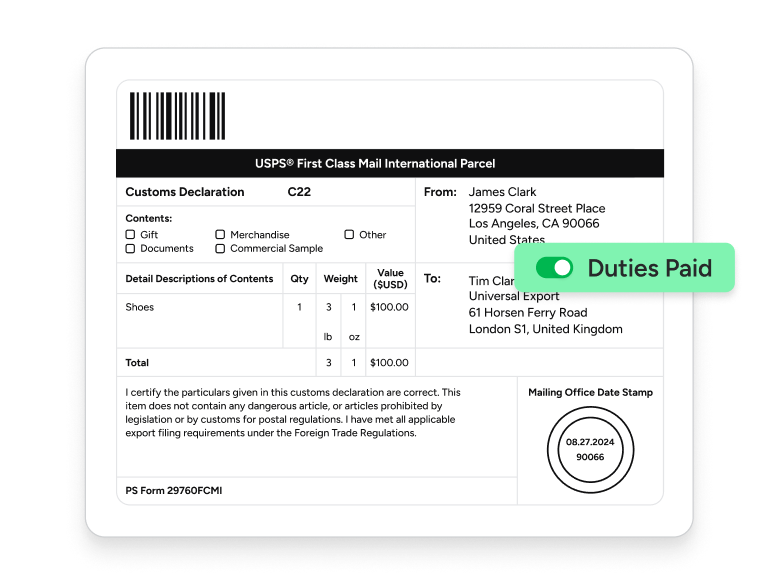
A large part of the improvement comes from reducing the administrative burden. Customs paperwork, product classifications, and tariff codes often cause shipment delays. When these details have to be entered manually, mistakes are common. Intelligent shipping systems automatically generate customs forms and shipping documentation using existing order and product data, reducing errors and facilitating smoother customs clearance.
Carrier selection is another area where technology helps remove complexity.
Different carriers have different strengths depending on the destination, and shipping costs can vary widely from one service to another. Instead of manually comparing options, systems can analyze delivery times, pricing, and destination requirements to instantly apply the best shipping option for each cross-border order.
Transparency is also improving the customer experience. By calculating duties and taxes in advance, businesses can show customers the full cost of international shipping at checkout rather than surprise them with extra fees at delivery.
Growth should not feel like an operational risk. It should be supported with a system that automatically manages the details behind global shipping by:
Optimizing international routing
Standardizing documentation
Selecting the most effective carrier
When the complexity of cross-border logistics is managed through data and automation, international shipping becomes manageable. The result is more predictable delivery and fewer unpleasant surprises. Businesses can focus on what matters most—reaching new customers and growing globally with confidence.
Customer Story
By consolidating labeling and customs documentation into a single platform within the same workflow used for domestic orders, May Lindstrom Skin began shipping across borders without facing more operational complexity or administrative work.
Today, shipping is one of the most strategic parts of modern commerce. It touches margin, speed, customer loyalty, and brand perception all at once. Yet many fulfillment systems were built for a simpler, manually-operated era that no longer exists.
When automation, real-time data, and machine learning operate together, fulfillment stops being a sequence of isolated actions. It becomes a connected decision engine.
Every shipment generates information. Every data point refines the next decision. The system improves as volume grows. The impact compounds quickly. The outcome is powerful.
In the end, the shift is not about replacing people with technology. It is about giving teams a better tool to make the right decisions in a more complex world.
Fulfillment will always be about delivering packages. But increasingly, success will depend on how intelligently those deliveries are orchestrated. The companies that embrace this shift today will be the ones best positioned to grow tomorrow.
Key takeaways
1
Ecommerce is getting harder to scale
Stronger competition, rising costs, and increasing customer expectations are putting pressure on retailers to operate more efficiently while still delivering better experiences.
2
Automation drive efficiency
Automating workflows allows businesses to process more orders, move faster, eliminate complexity, and lower error rates without increasing operational resources or headcount.
3
Shipping costs quietly erode margins
Without optimized rate selection, businesses overspend on shipping. Automation and real-time rate shopping can significantly reduce costs without sacrificing delivery performance.
4
Manual work slows fulfillment
Repetitive tasks and human intervention reduce speed, increase mistakes, and create bottlenecks as order volume grows.
5
Centralization creates control
Fragmented systems create inefficiencies and slow decision-making. Bringing orders, inventory, and data into one platform gives teams a single source of truth to manage operations effectively.
6
Data visibility improves decisions
Access to real-time insights across orders, carriers, and performance allows businesses to identify issues earl, optimize proactively, and improve the customer experience.
About ShipStation Intelligence
ShipStation Intelligence brings AI-powered delivery intelligence directly into your daily workflows, connecting data, automation, and real-time carrier performance into one unified layer behind every shipment. It's not another tool or dashboard. It's intelligence embedded into how shipping already happens.
It turns each shipment into data-driven action instead of treating shipping as a series of manual decisions. Teams reduce operational costs, automate rate shopping, and gain clear performance insight across carriers, channels, and fulfillment networks. They ship faster. They make fewer errors. All without adding complexity.
It's an entire ecosystem of connected capabilities built on real scale: more than $200B in global commerce, 3B orders processed annually, 3M+ customers worldwide, and connections to 300+ carriers. That scale matters. It means decisions are grounded in billions of real-world shipment data points—not guesswork.
Built for scale. Powered by intelligence.
Turn shipping into your competitive advantage with intelligence that improves with every order. Automate workflows, optimize rates in real time, and strengthen delivery performance across every shipment.
 Back
Back