Small BusinessesStart small, think big. Elevate your small-business shipping today.
Start Shipping in MinutesStart shipping instantly with a simple setup. Buy and print labels in minutes with no training needed and no unnecessary steps.
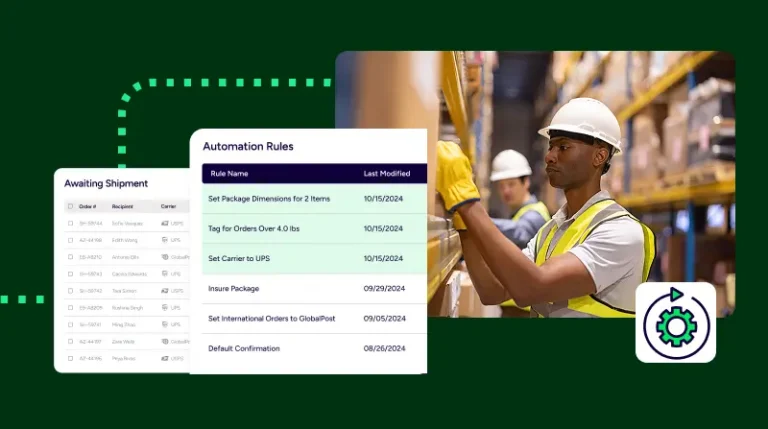
Automate and ScaleSave time with rules that batch, route, and print labels automatically so your shipping keeps up as orders grow.
Save on Every ShipmentAccess exclusive 80% – 90% discounts from every major carrier and cut costs on every label, no matter where you ship.
Connect and CustomizePlug into hundreds of stores, marketplaces, and carriers, or extend ShipStation with custom API integrations built for your business.
Manage Everything in One PlaceManage shipping, inventory, warehouse, tracking, and returns for all your stores and marketplaces in one simple platform.
Simplify ReturnsManage returns in one platform with prepaid labels and self-serve features that keep the process fast and frustration-free.
Get Up and Running QuicklyOur implementation team guides you through a step-by-step process to help you streamline workflows and keep costs minimized.
Mid-size and GrowingShip smarter, grow faster. Scale your fulfillment with ease.
Save on Shipping as you ScaleAutomate rate shopping across 200+ carriers, bring your own carrier accounts, and unlock deep volume discounts that grow with you.
Smarter Shipping IntelligenceTurn shipping into your competitive advantage with intelligence that improves with every order.
Centralize Omnichannel FulfillmentManage orders, shipping, inventory, warehouse operations, tracking, returns, and analytics across online stores and marketplaces with one platform.
Automate Order ManagementCombine AI intelligence with rule-based workflows to speed up fulfillment, streamline operations, and eliminate bottlenecks
Scale With our APIsExtend your setup using our developer-friendly API for custom automated workflows and insights.
Start with Guided OnboardingOur experts walk you through setup, training, and workflows so your team feels confident and ready to ship quickly.
EnterpriseGlobal scale, local precision. Master shipping at every level.
Lower Shipping Costs at Global ScaleReduce global shipping expenses with real-time rate shopping and discounted carrier rates, helping your enterprise control costs and ship efficiently at scale.
International Shipping Made SimpleEasily manage customs forms, duties, taxes, and tracking while accessing global carrier options from one platform built for cross-border shipping.
Fulfillment APIsCustomize workflows at scale with APIs for consolidating orders across channels, comparing shipping rates, validating addresses, tracking, analytics, and more.
Multi-Location FulfillmentManage inventory, orders, and shipping across multiple warehouses and stores with one platform built for multi-location fulfillment.
Advanced Shipping IntelligenceTurn shipping into your competitive advantage with intelligence that improves with every order.
Dedicated Guidance and SupportCount on 24x7 support plus dedicated onboarding guidance so your enterprise shipping runs reliably from day one and beyond.
How Guardian Sports Used Automated Returns to Scale After Going Viral with the NFL
After the NFL adopted their concussion-reducing Guardian Cap, this Atlanta-based sports safety company saw orders explode to 400 per day—and the team’s manual processes couldn’t keep up.
BlogGet the latest on carriers, shipping rates, Ecommerce trends, and emerging fulfillment technologies
Why Dev Teams Choose ShipStation APIOne API, 200+ carriers, 400+ integrations. See why dev teams choose ShipStation API for rate shopping, labels, tracking,...
Multi-Currency Invoicing for ShippingLearn how multi-currency invoicing for shipping simplifies global invoices, reduces errors, and helps you bill customers...
Shipping Delivery Exception Alerts GuideShipping delivery exception alerts explained: learn common causes, how to prevent delays, and what to check when a packa...
The conclusion is clear: AI is already influencing demand, competition, and delivery performance—and retailers that fail to adapt risk being excluded from AI-led shopping journeys altogether.
The conclusion is clear: AI is already influencing demand, competition, and delivery performance—and retailers that fail to adapt risk being excluded from AI-led shopping journeys altogether.
The conclusion is clear: AI is already influencing demand, competition, and delivery performance—and retailers that fail to adapt risk being excluded from AI-led shopping journeys altogether.
Should You Choose A Single-Carrier or Multi-Carrier Shipping Strategy?
Your shipping strategy is more than just logistics—it's a fundamental business decision that shapes your customer experience, operational efficiency, and competitive advantage. With rising customer expectations and increasing market pressures, ecommerce businesses choosing between single-carrier and multi-carrier approaches has never been more critical.
Your shipping strategy is more than just logistics—it’s a fundamental business decision that shapes your customer experience, operational efficiency, and competitive advantage. With rising customer expectations and increasing market pressures, ecommerce businesses choosing between single-carrier and multi-carrier approaches has never been more critical.
Let’s dive into both strategies to help you determine which approach will drive the most value for your business.
Key Takeaways:
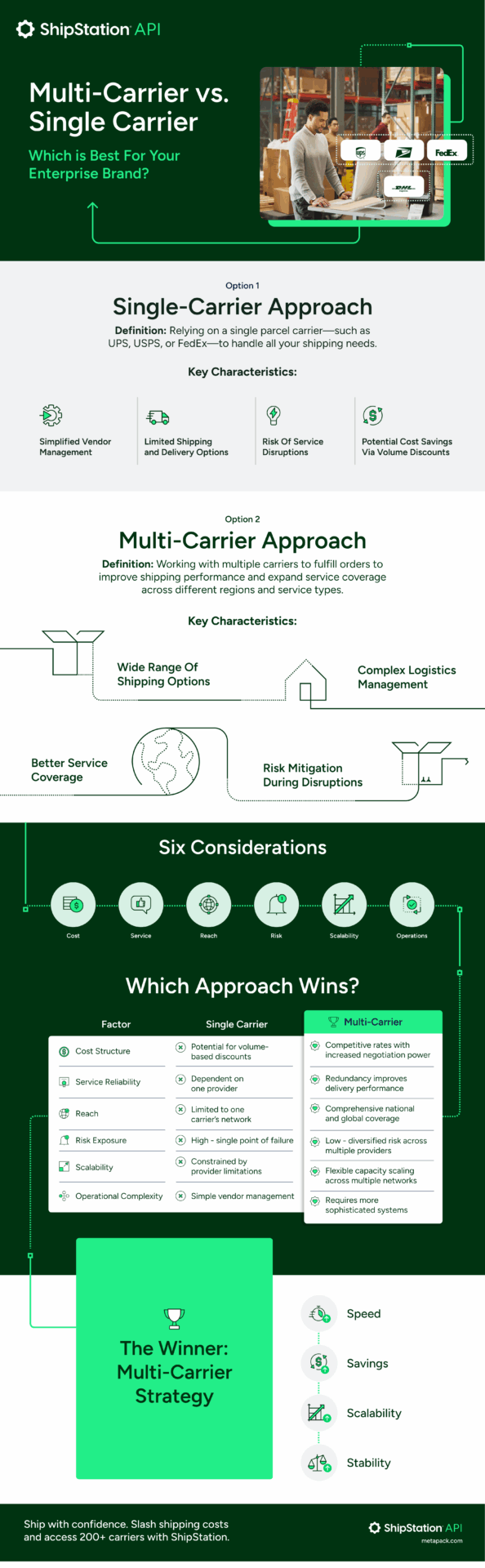
Single-carrier shipping streamlines operations by working with one primary shipping partner
Multi-carrier strategies distribute shipments across multiple carriers for optimized performance
Your ideal approach depends on business size, shipping volume, geographic reach, growth goals, and costs
What is Single-Carrier Shipping?
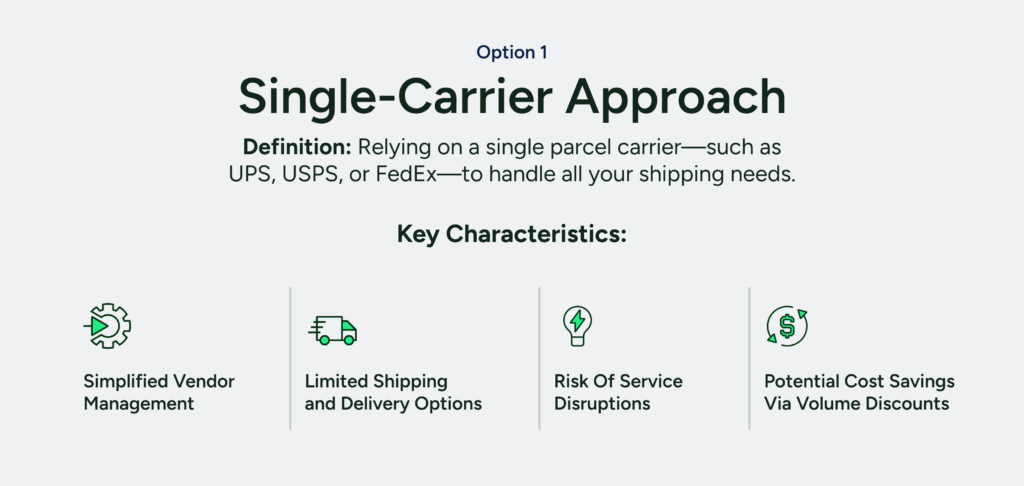
Single-carrier shipping relies on one primary carrier for all your shipping needs, both domestic and international. This consolidated approach creates a unified relationship for your entire logistics operation.
Many businesses start with this model because it feels more manageable: one contract to negotiate, one system to learn, and one relationship to maintain. Simple!
What is Multi-Carrier Shipping?
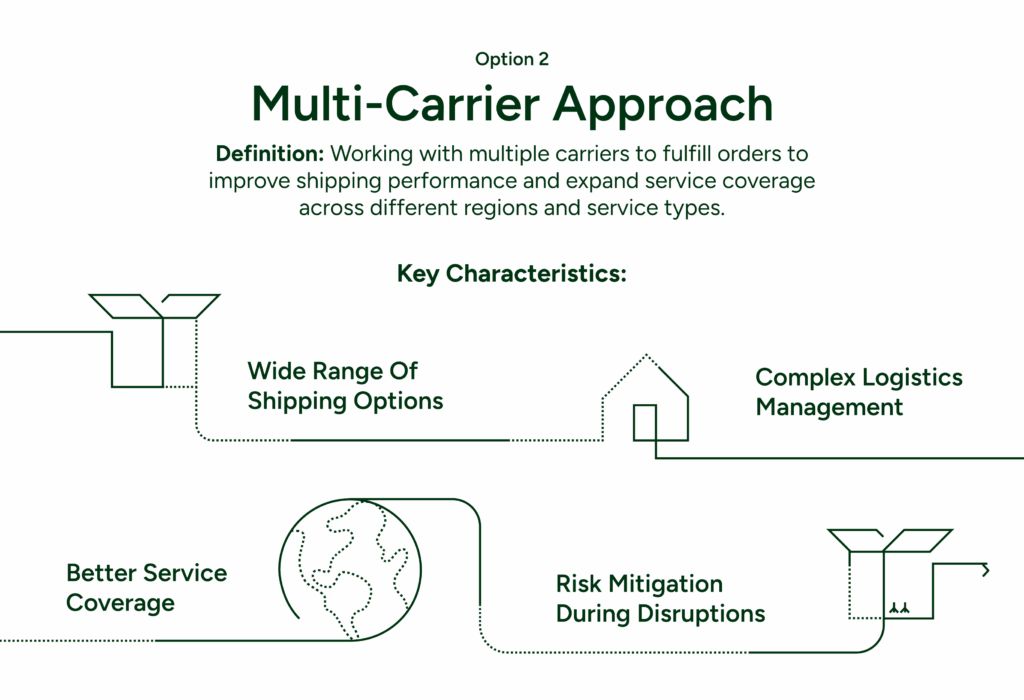
Multi-carrier shipping involves working with several different carriers, strategically selecting the best option for each individual shipment. Instead of defaulting to one shipping carrier, you evaluate factors like destination, package specifications, delivery requirements, and cost to choose the optimal carrier every time.
This approach transforms shipping from a one-size-fits-all solution into a customized strategy that adapts to each shipment’s unique needs.
Single-Carrier Shipping: Benefits and Drawbacks
With one system to learn and one contract to maintain, a single-carrier shipping approach may seem like the best option. But is it? Here are the advantages and disadvantages of single-carrier shipping:
The Advantages of Single-Carrier Shipping:
Streamlined Management: Managing one primary vendor relationship simplifies contract negotiations, system integrations, and day-to-day operations.
Volume-Based Savings: Concentrating your entire shipping volume with one carrier often unlocks significant discounts and preferential pricing tiers.
Partnership Benefits: Strategic relationships with your chosen carrier can result in enhanced support, priority service, and collaborative problem-solving.
The Challenges of Single-Carrier Shipping:
Service Limitations: You’re restricted to whatever services, coverage areas, and delivery options your shipping carrier provides.
Operational Vulnerability: Carrier disruptions, service outages, or capacity constraints can completely halt your shipping operations.
Weakened Leverage: Without competitive alternatives, your negotiating power diminishes over time, potentially leading to rate increases and service complacency.
Coverage Gaps: Geographic limitations and service quality variations can impact delivery performance in certain regions.
Multi-Carrier Shipping: Benefits and Drawbacks
If there are too many cooks in the kitchen, it’s often chaos. But when it comes to growing an ecommerce business, more shipping carriers may be the best option.
The Advantages of Multi-Carrier Shipping:
Service Optimization: Access to diverse delivery options, specialized services, and extensive coverage through multiple provider networks.
Improved Reliability: Built-in redundancy protects your operations from carrier-specific disruptions and capacity limitations.
Cost Competition: Leverage competitive dynamics between carriers to secure better rates and service terms.
Operational Flexibility: Quickly adapt to seasonal demands, new markets, and changing business requirements without being locked into one provider’s limitations.
Enhanced Coverage: Combine the strengths of different carriers to provide superior service across all geographic regions and delivery scenarios.
The Challenges of Multi-Carrier Shipping:
Management Complexity: Requires more sophisticated systems and processes to handle multiple carrier relationships effectively.
Administrative Overhead: More contracts to manage, integrations to maintain, and performance metrics to track across providers.
Service Consistency: Different carriers may have varying service standards, requiring more oversight to maintain consistent customer experiences.
Which Shipping Strategy Is Right For You?
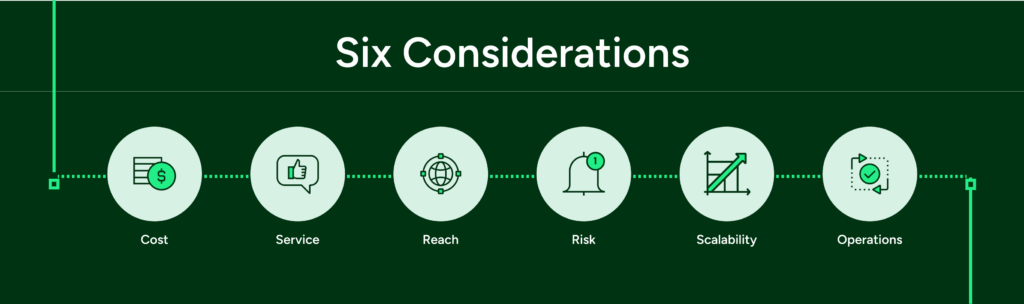
It depends. The right approach for your business depends on several critical factors:
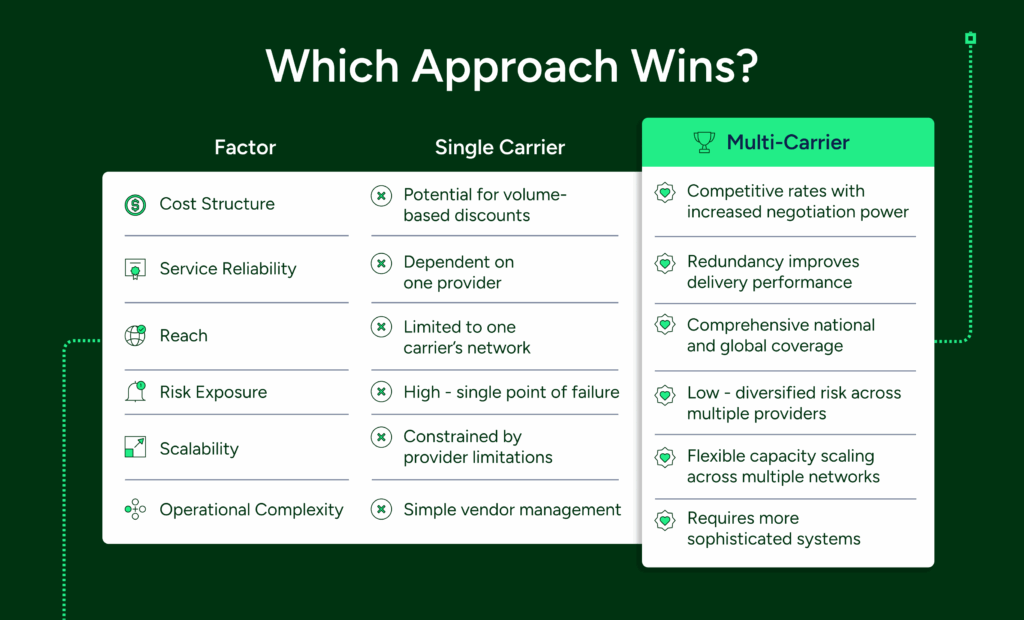
Cost Considerations: While single carriers offer volume discounts, multi-carrier strategies often deliver better overall value through rate competition and optimization opportunities across multiple providers.
Reliability Requirements: Single-carrier dependency creates vulnerability, while multi-carrier approaches build resilience through diversified options.
Geographic Scope: Single carriers limit you to one network’s reach, whereas multi-carrier strategies provide comprehensive coverage through combined provider strengths.
Risk Management: Single points of failure versus distributed risk—multi-carrier approaches significantly reduce operational vulnerability.
Growth Planning: Single carriers may constrain expansion when you reach their service or capacity limits, while multi-carrier strategies offer scalability and flexibility.
Operational Resources: Single carriers require less management complexity, though modern shipping platforms can effectively streamline multi-carrier operations.
Decision Framework: Multi-Carrier vs Single Carrier
Consider these scenarios when evaluating your options:
Choose Single-Carrier If:
You have limited resources for managing multiple vendor relationships
Your shipping volume is relatively low or concentrated in specific regions
Operational simplicity is your top priority
Choose Multi-Carrier If:
You experience significant seasonal volume fluctuations
You’re expanding into new geographic markets (especially international)
Shipping reliability and customer experience are critical differentiators
You want to optimize costs through competitive rate shopping
As customer expectations continue rising and competitive pressures intensify, companies relying solely on single-carrier approaches may find themselves at a substantial disadvantage. The businesses that will succeed are those that view multi-carrier complexity as a competitive advantage rather than an operational burden.
Transform Your Shipping Strategy with ShipStation
From ambitious startups to retail giants, multi-carrier shipping unlocks your shipping potential. ShipStation’s comprehensive platform connects you with dozens of carriers and hundreds of shipping services, giving you the flexibility to optimize every shipment while simplifying multi-carrier management. Our advanced shipping software eliminates the traditional complexity of multi-carrier strategies, providing automated carrier selection, rate comparison, and streamlined operations—all from a single, intuitive interface. Start your free trial here.
 Back
Back









































 Carriers & Rates