Back
Back






































 Ecommerce Growth


The post-peak returns surge is inevitable. Every year, retailers and ecommerce brands brace for the January reckoning—when holiday returns flood warehouses, margins shrink, and balance sheets take a hit. But what if ecommerce returns management didn’t have to be a necessary evil? What if reverse logistics could actually strengthen customer relationships and improve your bottom line?
In a recent webinar hosted by Supply Chain Dive, Rick Watson (CEO and Founder, RMW Commerce), Jeff Kaiden (CEO, Capacity LLC), and Matt Salmon (Sr. Product Manager, ShipStation) explored how modern ecommerce returns management technology and strategic thinking can help businesses of all sizes turn the returns challenge into a competitive advantage.
Returns aren’t simply about issuing refunds. The financial impact extends far beyond the initial transaction, creating a cascade of costs that can seriously damage profitability.
“As soon as you get into this sort of problem, you’re talking about losing the cost of goods,” Watson explained. “And the only thing you can do in return is to sell more products on the front end. How many products does it take to make up for losing the entire cost of goods in one purchase? Probably four or five, maybe more than that.”
When a customer returns a product, businesses face multiple cost layers:
Beyond operational challenges, returns fraud represents a growing threat that can devastate margins. Some customers have learned to exploit the system, taking advantage of generous return policies for personal gain.
“There comes a point in time where they [businesses] are just staring down a balance sheet that no longer makes any sense, because they’ve lost a ton of inventory that month,” Salmon noted.
Businesses often don’t realize the extent of the problem until financial statements reveal significant losses.
Returns abuse takes several forms, each with serious financial implications:
The challenge for retailers lies in protecting their bottom line without alienating legitimate customers who genuinely need to make returns.
Here’s the tension every retailer faces: consumers expect hassle-free returns, but generous policies invite abuse. Finding the right balance requires a combination of technology and strategy.
Today’s shoppers have high expectations shaped by major retailers offering free and easy returns with extended return windows. According to ShipStation’s Breaking Benchmarks report, 69% of consumers would switch brands for more convenient delivery or return options—a 25% increase from 2024. This dramatic shift highlights the growing importance of the returns experience in shaping customer loyalty.
Rather than applying blanket restrictions that frustrate good customers, modern returns management focuses on behavior-based policies.
“The only solution to minimize all these problems is customer-level return policies based on behavior,” Salmon explained.
This approach allows businesses to:
Watson emphasized the importance of data: “That kind of customer-level returns policy, or at least narrowing in on the worst actors and how to predict and identify them, seems like the only path forward.”
Modern ecommerce returns management technology addresses both sides of the equation—reducing operational costs while improving customer satisfaction. The right tools can turn a painful process into a seamless experience that actually builds loyalty.
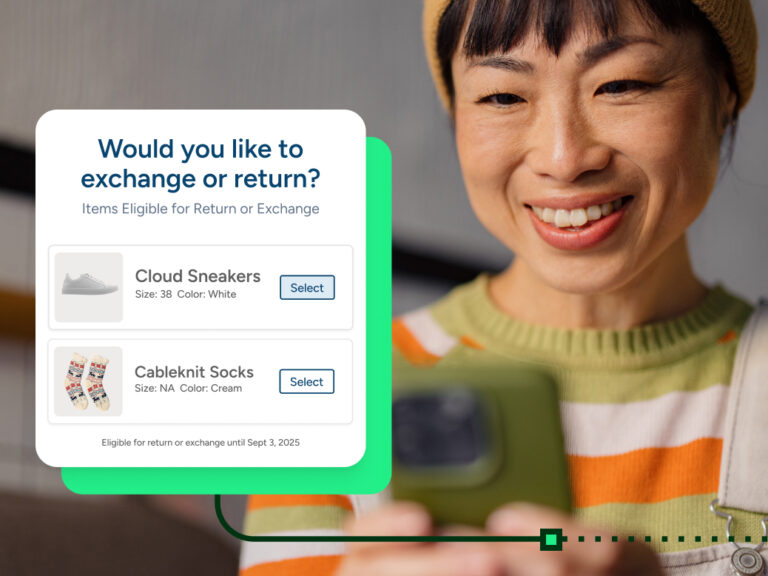
Traditional returns processes often require customers to email customer support, wait for responses, and navigate unclear policies. This creates frustration on both sides.
“When they [companies] switch to a self-service platform, it allows a consumer to figure out really quickly where they stand in that returns process without having to wait around for an interaction with customer support,” Salmon said.
This approach delivers multiple benefits:
“It [a self-service platform] allows you to let people solve their own problems themselves, and get that dopamine instantly that they’re chasing in a returns life cycle, and then, with that, ideally become a repeat customer,” Salmon added.
Sometimes the cost of processing a return exceeds the item’s value. Green returns—allowing customers to keep low-value items while still receiving refunds—deliver a double win: reducing your reverse logistics costs while cutting carbon emissions from unnecessary shipping. It’s a strategy that saves money, helps the environment, and delights customers all at once.
This strategy works best for:
Not all returns must result in lost revenue. Technology that promotes exchanges over refunds can recapture significant value.
“We see merchants that are able to retain about 30% of their revenue using ShipStation at the moment that they would have otherwise lost to refunds,” Salmon explained.
Successful strategies include:
Ecommerce businesses like Allure Wedding Jewelry have successfully implemented streamlined returns processes that turn potential losses into opportunities for customer retention and repeat purchases.
Returns aren’t just a cost center—they’re a goldmine of product feedback that can drive meaningful improvements.
“There is a revenue opportunity in returns data,” Watson noted. “There is a reason that you can improve your products through return status. Maybe your product isn’t as good as you thought it was, and it fails if you use it in these ways, and that’s why the person’s returning it.”
Historically, analyzing return data required manual review and categorization. Modern AI tools can process thousands of returns instantly to identify patterns and trends.
“If there are 10,000 discrete returns dealing with the same issue or a bunch of different issues, AI can actually help with that. In three minutes, the system can tell you what you should be focusing on in terms of your product fixing journey.”
Jeff Kaiden, CEO, Capacity LLC
“If there are 10,000 discrete returns dealing with the same issue or a bunch of different issues, AI can actually help with that,” Kaiden explained. “In three minutes, the system can tell you what you should be focusing on in terms of your product fixing journey.”
This capability transforms how businesses use returns data:
Watson added that AI eliminates the need for structured data: “We used to have to get very structured data and force people to pick the reason why they were returning. Now, AI doesn’t care about any of that. It will summarize it all for you very simply.”
Implementing ecommerce returns management technology only works if you can measure its impact. The panelists emphasized the importance of focusing on metrics that directly impact business outcomes.
Watson identified one overarching goal.
“There’s always been one golden metric, which is the perfect order. The perfect order is the product the customer wanted, they got it on time, no refund or return required, end of story.”
Rick Watson, CEO & Founder, RMW Commerce
This single metric encompasses everything: accurate inventory, correct fulfillment, quality products, clear descriptions, and on-time delivery.
Beyond the perfect order, businesses should monitor:
While technology solves many customer-facing challenges, the physical side of returns processing remains labor-intensive.
“It’s not a great candidate for too much automation,” Kaiden acknowledged. “There could be smell issues, there are repackaging issues, there are defect issues that we may or may not be able to tell. These are sort of physical human examination steps, and it’s really hard to imagine this particular function being next in line for warehouse automation.”
Even without full automation, smart warehouse practices can reduce costs:
The holiday shopping season creates a predictable surge in returns every January. Preparation is essential.
To handle the post-peak returns crunch, businesses should:
Clear communication prevents confusion and reduces customer service inquiries:
Forward-thinking brands recognize that ecommerce returns management is no longer just damage control—it’s an opportunity to differentiate and build loyalty.
Transform reverse logistics from an afterthought into a competitive advantage. Companies that invest in seamless, customer-friendly returns experiences while controlling costs through innovative technology and data-driven policies will win in an increasingly competitive market.
The best returns programs share common characteristics:
The post-peak returns surge is coming. The question isn’t whether you’ll face returns—it’s whether you’ll be ready to turn them into an opportunity.
Modern ecommerce returns management technology enables you to deliver exceptional customer experiences while protecting your margins and gathering insights to enhance your products. The retailers and ecommerce brands that thrive will be those who stop treating returns as a necessary evil and start seeing them as a strategic capability that drives growth.
Ready to reimagine your returns process? Explore how ShipStation’s returns management solutions can help you streamline operations, reduce costs, and turn returns into a loyalty driver this peak season and beyond.
Ready to reimagine your returns process? Start your free trial with ShipStation to streamline operations, reduce costs, and turn returns into a loyalty driver this peak season and beyond.