Back
Back



































 Shipping & Fulfillment


Industry leaders often ask how our shipping optimization products solve their specific challenges. To explore this for the automotive sector, we sat down with Brandon Checketts, CEO of X-Cart, an ecommerce platform for auto parts retailers, and Maia Tarver, Senior Product Manager of ShipStation, a shipping solution for merchants of all sizes.
Auto parts fulfillment is uniquely complex, and understanding the reasons behind those challenges helps sellers create more efficient and scalable workflows. While technology can streamline the work, having a strong foundational understanding of what influences cost, speed, and accuracy is equally important. Automation and integration tools, like ShipStation, can help merchants focus on strategy rather than repetitive tasks.
In this Q&A, we dive into auto parts shipping challenges and provide answers to the most pressing questions about shipping automation.
This variety creates massive challenges in packaging, cost calculation, and compliance. First, you have fragile and high-value items that need extensive packaging to prevent damage.
Then, you have to ship heavy and bulky parts. These parts are oversized. They can’t be sent by regular post and fall into expensive oversized categories or require specialized less-than-truckload freight.
Many items, like batteries or certain fluids, are also subject to strict shipping regulations and surcharges because they fall under the category of hazardous materials (Hazmat). ShipStation enables sellers to automatically flag and track such items, helping to reduce compliance errors. It’s a logistics-heavy business before the part even leaves the warehouse.
From our experience, the challenges stack up, but the most consistent pain point is controlling shipping costs, especially for bulky or heavy items. Carriers charge based on dimensional weight (the space a part occupies), which means a large but light item can cost more to ship than a small and heavy one. Many sellers don’t have a way to calculate this accurately upfront.
This is linked to the time-consuming manual decision of selecting the right shipping method for every order. You can’t ship a bumper the same way you ship a gasket, so staff get stuck choosing between standard mail and LTL freight.
In addition to all that, you face the physical challenge of preventing damage during transit. A customer who receives a damaged part loses trust in your company.
Finally, even after the package leaves your warehouse, customers often demand to know its location. ShipStation’s tracking notifications can automatically update customers, reducing the volume of “Where is my order?” inquiries.
Many sellers don’t realize how much of this workload can be reduced simply by standardizing their internal decision-making processes. Documenting how different product types should be handled—including packaging requirements, preferred services, and inspection steps—creates consistency that lowers cost and prevents repeat mistakes.
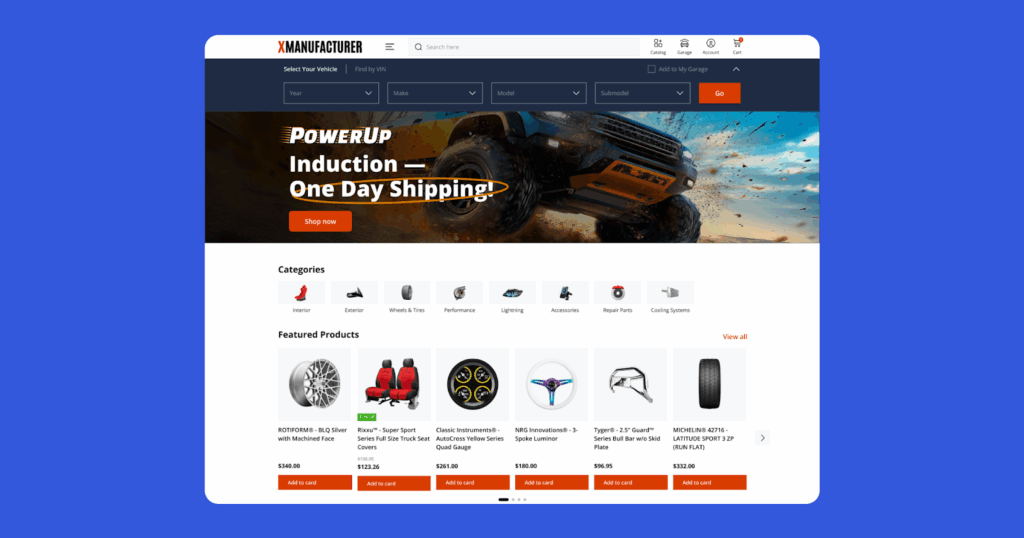
A strong, integrated suite is your central command center. It simplifies things by automating the decisions you’d otherwise make manually every day.
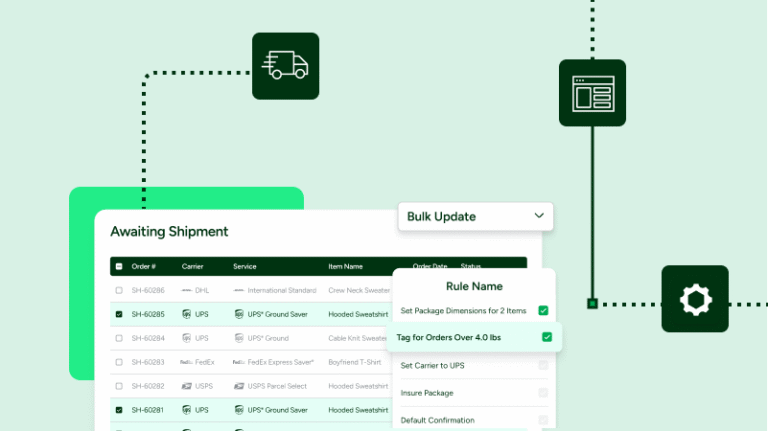
For example, instead of manually checking each order, you can set automation rules. A rule in ShipStation could be: “IF product weight is > 150 lbs OR order dimensions are ‘oversized’, THEN assign ‘LTL Freight Carrier’ and ‘Hold for Review’.”
This type of automation reduces errors, speeds up fulfillment, and ensures that the correct shipping method is always selected. It automatically syncs order details, product weights, and dimensions from X-Cart, so you can stop the one-by-one process and batch-print hundreds of labels in minutes.
You need multi-channel integration to prevent overselling and streamline your fulfillment process. From our end, an order is an order, and we need to pull it in regardless of the source.
Imagine you have one last part in stock. A customer buys it on your X-Cart store. An integrated system like ShipStation pulls that order, and as it’s processed, it tells X-Cart, which then updates your inventory on eBay and Amazon to zero. Without that sync, you could sell that same part on eBay minutes later, forcing you to cancel an order and lose a customer.
Connecting ShipStation to a platform like X-Cart also means that all your orders, regardless of their origin, appear in a single dashboard.
Centralizing orders in a single dashboard provides sellers with a clear, real-time view of all sales and fulfillment activities.
Absolutely. This is, in fact, one of the most significant and immediate impacts our customers experience. The savings come from several different sources.
Right out of the box, when you connect a tool like ShipStation, you get access to pre-negotiated, discounted shipping rates. The rates we have with major carriers like UPS, USPS, and FedEx are almost always lower than the rates you could get on your own. That’s an immediate saving on every label you print.
However, the real power lies in rate shopping in real-time. For every single order that comes in, the system can compare all your carrier options. You might see that for a 5-pound part going to Texas, UPS Ground is $2 cheaper than FedEx. But for a 1-pound part going to New York, USPS is the cheapest. When you multiply these small savings by hundreds or thousands of orders, it adds up to a massive amount of money saved at the end of the year.
These tools help you stop bleeding money on hidden fees and surcharges, too. They are smart enough to correctly calculate dimensional weight for large or small parts and identify additional fees for services like residential delivery. You see the total cost upfront, which means no more surprise bills from your carriers a month later. You get to make the most cost-effective choice every time.
Smart shipping tools, like ShipStation, also calculate dimensional weight and flag extra fees, so sellers see total costs upfront and avoid surprise bills later.
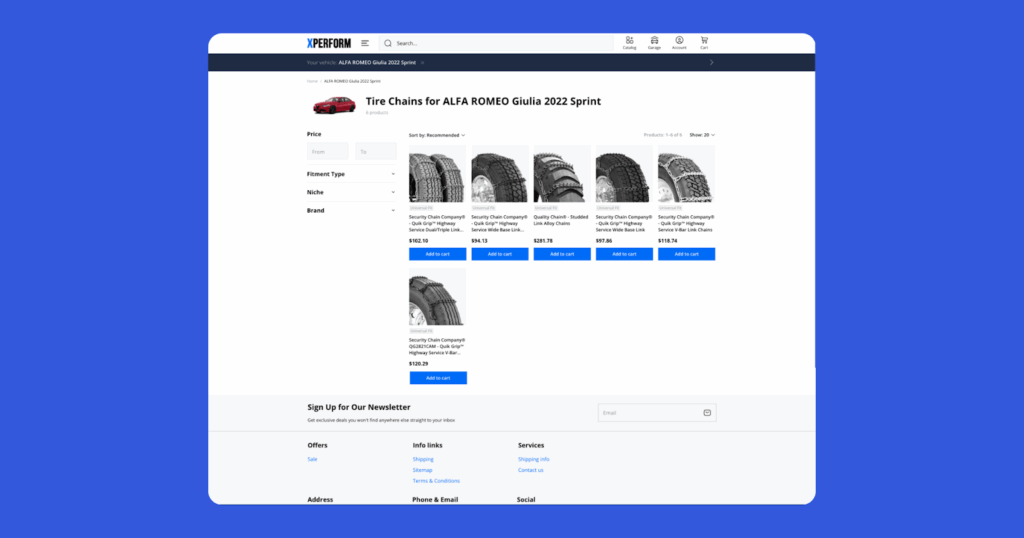
That’s a constant balancing act, and the right choice depends on both the customer and the part itself.
As you mentioned, you have professional shops that require it quickly and are willing to pay for expedited shipping. Then you have the hobbyists who are almost always going to choose the 5-7 day ground shipping if it saves them $10.
A good tech platform helps you offer these different options at checkout. But beyond choice, the part in question dictates the method. You can’t send a 160-pound part via USPS; it must be shipped via LTL freight. Your system needs to be smart enough to recognize that part’s weight and dimensions (passed from X-Cart) and automatically apply the correct freight rules so you aren’t even given the option to choose an invalid service.
Oh, it’s absolutely critical, because think about what happens without one. You’re basically running two separate businesses. An order comes into your X-Cart store, and what’s your next step? You have to manually export that order, maybe into a spreadsheet.
Then, you need to visit your carrier’s website or a separate shipping program and enter the customer’s name, address, and all the order details.
Once you finally print the label, you’re still not done. You have to take that tracking number, go back into X-Cart, find the original order, and paste it in to mark it as shipped.
When you’re handling more than a few orders a day, that process is a recipe for disaster. You can copy the wrong address, paste the wrong tracking number, or get buried in busywork. ShipStation eliminates these manual steps, providing a seamless connection between storefront, carrier, and customer.
The moment you do, you get the tracking number and shipped status right back to your online store, which then notifies your customer. It connects your storefront, shipping station, and customer in one automated loop.
The most important thing is that your shipping platform must integrate with your ecommerce platform. You’ve already done the hard work of handling parts compatibility and fitment data in X-Cart; your shipping tool needs to be able to use that data.
Look for that one-click connection to a powerful order management solution.
Next, consider automation and scalability. As you grow, you can’t be doing things one by one. Ask yourself:
And finally, make sure it provides analytics. You need data. You need to be able to view a dashboard, track your shipping efficiency, identify your true costs, and monitor delivery times. ShipStation gives that visibility without adding manual reporting work. That’s how you know what’s working and where you need to improve.
ShipStation’s seamless integration with X-Cart gives you the automation, multi-carrier access, and cost control you need to scale your auto parts business. Stop wrestling with manual auto parts shipping challenges and start shipping smarter.
Start your free 30-day trial—no credit card required—and see how ShipStation and X-Cart work together to streamline your operations from order to delivery.