Back
Back







































 Ecommerce Growth


This article shares insights from expert-backed sessions on ecommerce delivery, AI, sustainability, logistics, and more at The Delivery Conference 2026.Watch all of the event sessions on-demand.
A retailer recently told Nick Ciubotariu something that stuck with him. They said they wished their team could stop fighting amongst themselves over 12 competing spreadsheets—each one claiming to be the right version of the truth.
Ciubotariu, Auctane’s chief technology officer, shared the story during the Delivery Intelligence session at The Delivery Conference 2026 (TDC), an annual gathering of retail, logistics, and delivery leaders held in London. And it landed because it’s not a fringe problem. Most ecommerce businesses aren’t short on data. They’re short on ways to turn that data into decisions.
“We’ve not done a good job of turning data into actionable, useful information that drives the business,” Ciubotariu said. “From a leadership perspective, that has to be a building block—you’re seeking predictive outcomes rather than waiting to see what comes next. Because by then, it may already be too late.”
That tension—between having data and actually using it—ran through several sessions at TDC this year. Speakers challenged merchants at every scale to rethink the intelligence layer in their shipping operations, not as a feature to eventually switch on but as a competitive foundation. Here’s what that looks like in practice.
One of the sharpest distinctions in the Delivery Intelligence session came from JJ Karambelas, channel director at OneStock. He drew a clear line between what data tells you after the fact and what intelligence enables before a problem occurs.
“Using data lets you make those manual decisions on the fly when you need to,” Karambelas said. “Intelligence really lets you predict—how do we handle this exception? How do we predict what this scenario that’s happened before is? Let’s automate that, rather than reacting on the fly.”
It’s a distinction worth sitting with. Reaction is about managing what’s already gone wrong. Prediction is about seeing the pattern before it becomes a problem.
“Intelligence really lets you predict… rather than reacting on the fly.”
JJ Karambelas, OneStock
The example Ciubotariu gave to illustrate this was simple but clarifying. If carrier A is late 12% of the time, that’s a report—a number you get after analyzing historical data. Intelligence is different. It says: use carriers B, C, and D for these scenarios—perhaps because of that track record, perhaps for other reasons. It makes the decision for you, automatically, without requiring someone to weigh the options on each order.
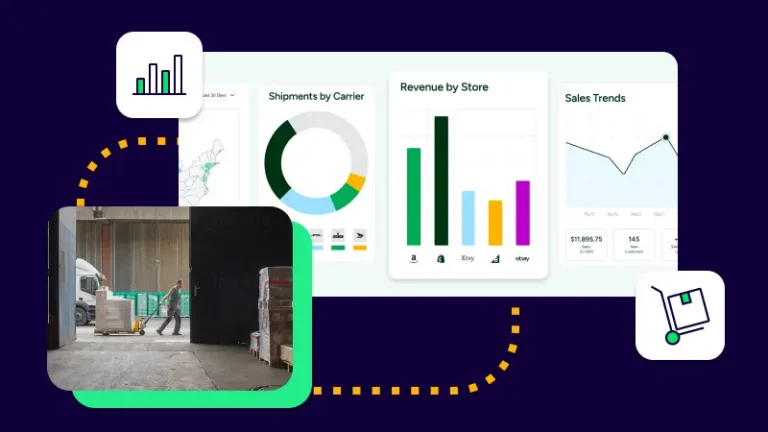
ShipStation’s Analytics gives you that reporting foundation—carrier performance over time, shipping cost trends, delivery outcomes by service level. But the shift Ciubotariu was describing is what happens when that data becomes the input for rules that act in real time. Rate Shopper and Automation rules encode that logic: applying consistent carrier selection criteria and flagging orders that need special handling. These features let the system apply it at volume, without requiring someone to evaluate each order individually.
Both Ciubotariu and Karambelas made the same point from different angles: if you wait until after an order is placed to start making smart decisions, you’re already behind.
Karambelas framed it around intent. Delivery intelligence, in his view, starts at the pre-purchase moment—the promise you’re committing to a customer before they’ve clicked buy. That promise only holds if your upstream data is doing work before the order hits the queue.
“If you start after [the order is placed], you’re already too late.”
Nick Ciubotariu, Auctane
For merchants, the upstream application of this is inventory. ShipStation’s Reorder Assist applies the same logic at the stock level—analyzing historical order data and trends to surface restocking signals before a stockout reaches your fulfillment queue. The goal is the same as what Ciubotariu was describing: predictive outcomes rather than reactive cleanup. You’re not waiting for the problem to show up. You’re seeing it coming.
Emma Clarke, who heads product at Metapack, framed the underlying challenge clearly in the Unveiling Future of Intelligent Delivery session: “We now have more data than ever before, but we often have less clarity than ever.”
That gap—between data volume and actual visibility—is what predictive tooling is designed to close. The shift Clarke described is from reacting to delivery issues after they’ve already affected a customer, to staying ahead of them entirely. The mechanism is pattern recognition at scale: analyzing live and historical order and operational events to identify which shipments are at risk before anything has gone wrong.
For merchants, that same logic applies closer to home. ShipStation’s Analytics gives you the performance data—carrier trends, delivery outcomes, cost patterns over time—that makes it possible to spot where your operation is drifting before it becomes a problem order. The goal is the same: fewer surprises, more time to act.
In the same session, Matthew Trattles, VP of Product at Auctane, made clear that the expectation gap isn’t just an enterprise problem anymore.
“Consistency, convenience, and affordability are not nice to have,” Trattles said. “They’re indispensable. There’s no leeway, and there’s no excuses.” The same customers who expect seamless delivery from the largest retailers bring those expectations to every merchant they buy from, regardless of size.
Intelligent shipping automation is what lets mid-market merchants meet those expectations without building an enterprise operations team. Auto-split and auto-routing capabilities handle multi-item orders automatically—dividing them across fulfillment locations, assigning the right carrier based on your defined logic, processing them without requiring someone to evaluate each case by hand. SmartFill reduces front-end friction further, auto-populating shipment details from order history to cut manual entry at volume.
Clarke put some scale to the complexity this kind of logic can manage: some Metapack customers are working with 30,000 allocation rules. The merchant-level version of that is different in size but identical in kind—and intelligent shipping automation is what keeps that complexity from becoming a daily manual burden.
Michael Anderson, managing consultant at Place-B Consultancy, opened the Predictive Shipping session with a line from a former managing director: “Service is our only product.” The point being—whatever you promise at checkout, the only thing that matters is whether you can actually deliver it.
Luke Sneddon, head of product for supply chain and logistics at Satalia, spent much of the session unpacking what it actually takes to move from reactive to predictive. His biggest caution was about a misconception he runs into constantly: that having historical data means you can predict the future.
“You can’t purely predict the future based on what happened in the past,” Sneddon said. “You have to blend the two—the order dataset and the situational context that impacts it. If you don’t have both, you’re not going to predict with any degree of certainty.”
The result, when the shift happens, isn’t just better decisions. It’s a different relationship with time. Sneddon described a client whose planning team, after implementing route optimization, could monitor seven days out—knowing today about a problem likely to surface next week, with enough runway to address it before a single customer was affected. Their planners stopped living in the current day and started looking forward.
That’s the real value of intelligent shipping automation: not that it eliminates judgment. It moves the moment of judgment earlier in the process, when there are still options on the table.
Alistair McAuley, founder and CEO of TradeKart, put a fine point on the behavioral shift that predictive operations make possible in the Instant Impact session. TradeKart connects tradespeople with local merchants for on-demand delivery—often within 30 minutes—using Uber Direct’s courier network. His go-to example was a London plumber named Matt Wyatt who does eight jobs a day, arrives on the tube with tools and no materials, and gets everything he needs delivered to the job site. The supply run is gone. The van is gone. The model only exists because the operational layer was built to support it.
“The next generation of tradespeople are growing up with this on-demand expectation,” McAuley said. “And convenience is going to be key.”
Not every merchant is building a 30-minute delivery network. But the dynamic is the same at any scale: when your shipping operations are genuinely intelligent—forecasting demand, routing automatically, applying consistent carrier logic—the capacity that was going to operational triage gets freed up. That capacity can go toward growth instead.
Ciubotariu’s closing takeaway from the Delivery Intelligence session was unambiguous: “If you’re not investing in it, you should be today. Because if you’re not, and you continue to not be, you’re falling behind those that are.”
Your shipping data is already there. ShipStation helps you put it to work.