Back
Back










































 Small Business Resources


Creativity isn’t magic—it’s a skill you can develop through deliberate practice.
The myth that creativity is a talent that you’re born with stops more business innovation than any external barrier. Christina Tosi, founder of Milk Bar and two-time James Beard award winner, destroys this limiting belief with a simple truth:
“We’re not more creative than any of you. We’re creative and we’re good at it because we work hard at it every single day.”
In this blog, you’ll learn how to develop business creativity through proven frameworks, discover why changing your environment sparks breakthrough thinking, and master the practical techniques that turn ordinary business challenges into innovative solutions.
This article shares insights from ShipStation’s Innovation Delivered summit. Ecommerce experts shared tips for building strong businesses that focus on customers. Learn more about Innovation Delivered and watch all event sessions here.
Tosi compares the development of creativity to any other professional skill, much like learning a new language or practicing meditation. The more you practice creative thinking, the better you become at generating innovative solutions.
This reframe changes everything for business owners who dismiss themselves as “not creative people.” You don’t need conventional artistic talent to develop business innovation skills. You need consistent practice and the right approach to problem-solving.
At Milk Bar, for example, creativity isn’t left to inspiration—the idea for its best-selling cereal milk soft serve didn’t happen by chance. It’s a systematic process that occurs daily through deliberate exercises, environmental adjustments, and iterative thinking.
Tosi’s cereal milk breakthrough came from leaving her professional kitchen and wandering into a bodega. When traditional recipe development wasn’t working, she changed her environment and asked different questions.
This approach has scientific backing. Stanford University research shows creative output increases by 60% when walking versus sitting at a desk. Your physical environment shapes your mental possibilities.
“When you train yourself to get up and out of your normal environment and experience everyday stuff with open eyes, you’re going to be overwhelmed by what the world has to offer you and what you in return can pull out to create, to access that wild part of your brain where all the good ideas are waiting.” – Christina Tosi, CEO, Milk Bar
Picture this: you arrive early to work at a restaurant with almost empty fridges—just eggs and cream. How can you impress restaurant-goers with just eggs and cream? This happened to Tosi, and she felt defeated… until she discovered a Southern recipe for “chess pie,” made when you don’t have enough ingredients for anything else.
She put her own twist on the dessert, and later, it single-handedly kick-started Milk Bar’s DTC business. The constraint forced innovative thinking that abundance couldn’t, and it changed the trajectory of her career.
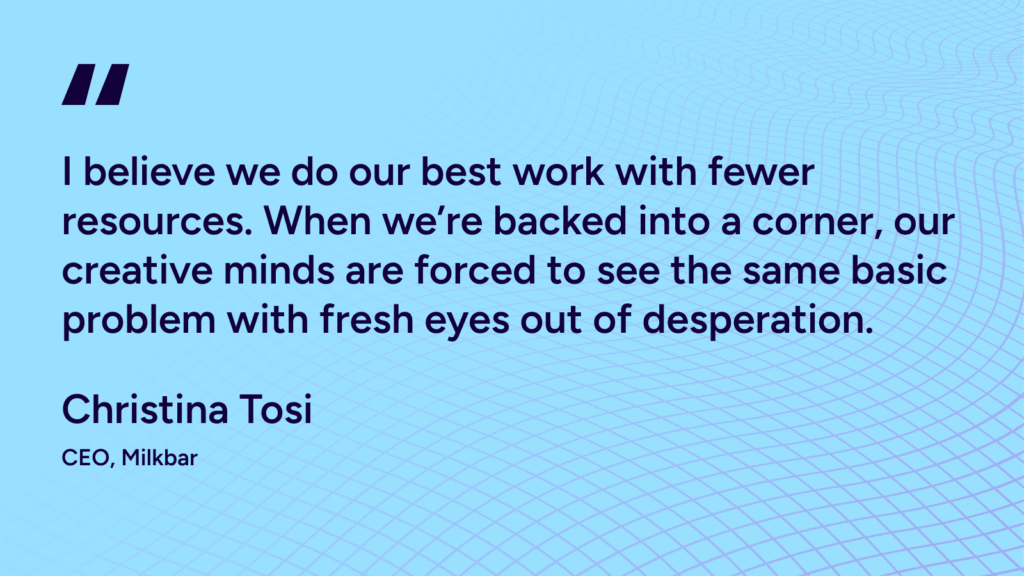
“I believe we do our best work with fewer resources. When we’re backed into a corner, our creative minds are forced to see the same basic problem with fresh eyes out of desperation.” – Christina Tosi, CEO, Milk Bar
Ecommerce brands face many constraints, whether it be budgetary, technological, or other resources. That’s when you need to create a killer “chess pie.” Try to use constraints creatively by:
How do you know when a creative idea deserves investment versus when it’s just interesting? Tosi applies the “obsession test”: “Don’t stop until you’re obsessed with it. For me, that means I’ve been surrounded by dessert all day, but I still think about that one when I get home.”
Her birthday cake took two years of development because just “good” wasn’t enough. It needed to be unforgettable. The result became Milk Bar’s best-selling cake because it passed the “obsession test” for both the creator and customers.
To see if your ideas pass the obsession test, ask yourself:
In an AI-driven world, your unique perspective becomes increasingly valuable. Start treating creativity like any professional skill you want to develop. Practice regularly, create the right conditions, and trust the process.
The question isn’t whether you’re creative enough—it’s whether you’re willing to practice creativity consistently enough to unlock your business’s innovative potential.
Want to learn more about how to unlock a more creative mindset? Watch the full session from Innovation Delivered here.