Back
Back









































 Enterprise Business Resources


High-volume shippers face unique challenges that can make or break their ecommerce operations. When you’re processing thousands—or tens of thousands—of orders each month, the margin for error shrinks while the demand for speed, accuracy, and cost-efficiency multiplies. Manual processes that worked for shipping 500 packages per month become bottlenecks when scaled to enterprise-level shipment volumes.
Enterprise shipping operations require sophisticated, robust technology designed to handle the complexities of large-scale fulfillment. Without a solution that creates a seamless shipping experience, brands face mounting costs, increased error rates, and frustrated customers.
The fundamental value proposition is simple: automate repetitive tasks, eliminate manual data entry, reduce errors, and process exponentially more orders without proportionally increasing headcount or operational costs.
But the devil is in the details. This guide helps you understand which capabilities matter most for high-volume operations, so you can make the right investment.
Labor-intensive shipping operations drain resources and increase costs. Enterprise automation changes this dramatically, as sophisticated workflows decrease labor and processing times. changes this dramatically. Sophisticated workflows can decrease labor and processing time by 66%.
Shipping software can create rules that automate routine decisions across thousands of shipments, removing repetitive tasks and time-consuming steps and enabling leaders to redirect human resources toward higher-value activities.
Automation allows scaling order volume without proportional increases in cost. An operation processing 10,000 monthly orders can scale to 20,000 without doubling the number of employees.
Without automation, warehouse workers must manually determine the optimal carriers for each shipment, select the appropriate service levels, calculate shipping costs, verify addresses, route orders to the correct warehouses, and update inventory across multiple systems. Multiply these decisions across hundreds of daily orders, and errors, slowdowns, and inconsistencies become inevitable.
Intelligent shipping software transforms chaos into clarity, making complex operations manageable through automated decision-making based on predefined business rules.
The system selects the most cost-effective carrier service that meets delivery requirements, validates addresses to prevent costly shipping errors, and updates inventory seamlessly across all sales channels without manual intervention. Barcode-scanning integration accelerates picking and packing, and batch processing updates shipping statuses and prints thousands of shipping labels simultaneously. Meanwhile, key fulfillment milestones trigger automatic customer notifications and alert you of situations that require extra attention.
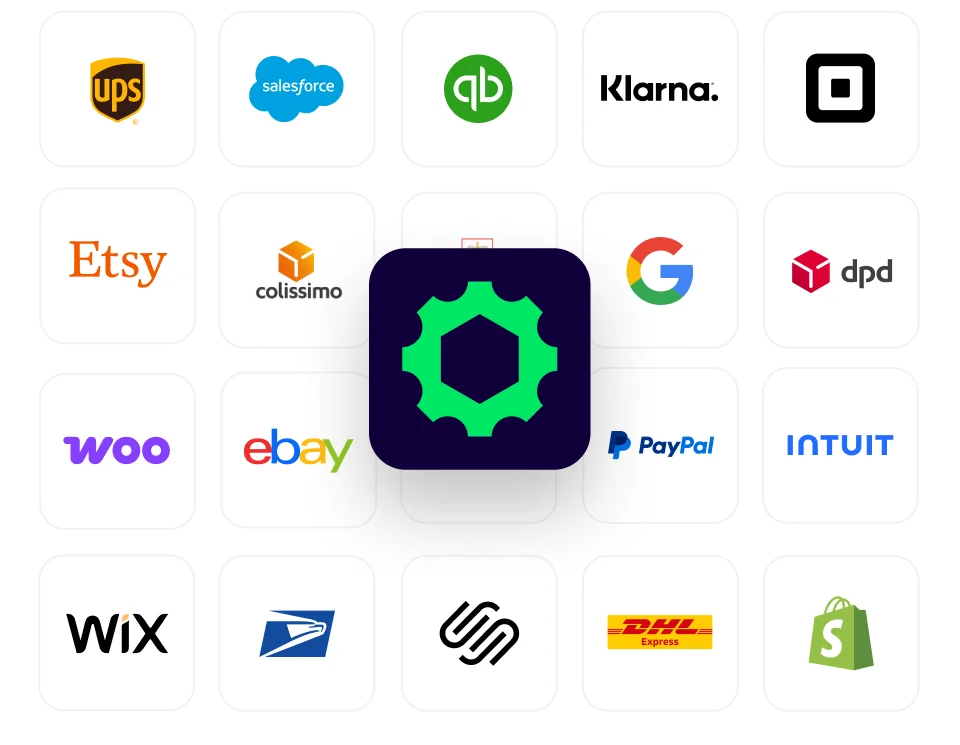
Modern enterprise shipping platforms integrate directly with platforms and technology solutions—no workarounds necessary. These integrations can include ecommerce platforms, marketplaces, major carriers, ERP systems, warehouse management solutions, CRMs, and custom databases.
Ultimately, automation drives measurable improvements in cost efficiency, accuracy, reliability, customer satisfaction, and scalability—the metrics that actually increase profitability and turn fulfillment from a cost center requiring constant oversight to a competitive advantage.
Software built for high volume lets you fulfill orders however you want. It automatically splits or routes orders based on inventory availability, customer proximity, and shipping requirements, resulting in fewer shipments, lower overall shipping costs, and decreased time-in-transit.
With auto-splitting, the system divides orders into multiple shipments when items must ship separately due to weight restrictions, different warehouse locations, or partial fulfillment requirements.
This helps manage orders that need unique handling, contain oversized items, are too heavy for a single box, or include products on backorder.
If your products are bulky and awkwardly shaped, there’s little chance you’ll fit them all into a single package. Similarly, if you need to ship really heavy items, you’ll likely need to split orders into a few packages that are easier to handle in transit and don’t cost a fortune to ship. In many cases, it may be cheaper to send two smaller packages rather than one large one.
Auto-routing determines the most efficient way to fulfill orders and routes them to the optimal fulfillment locations based on which warehouses are closest to the recipient’s address and which ones stock the items. It also groups products that can be shipped together from a single location, enabling faster delivery to your customers.
With these order automation capabilities, you can prioritize shipping by proximity, create as many individual shipments as needed, reduce the number of locations required to fulfill an order, and avoid splitting an order unless necessary.
Operational data isn’t just interesting. It’s essential for unlocking insights that drive business impact.
Every shipment generates dozens of data points: carrier selection, service level, transit time, delivery status, cost, zone, weight, dimensions, and exceptions. Multiply this across tens of thousands of monthly shipments, and you’re generating millions of data points that either drive strategic advantage or remain untapped potential.
The challenge isn’t collecting data—it’s turning raw shipping data into insights that actually improve performance and efficiency, reduce costs, and enhance customer experience.
Most enterprise shippers operate partially blind to their true shipping performance. They know overall volumes and total costs, but lack granular visibility into what’s actually happening across carriers, service levels, and zones.
You can’t improve what you can’t measure, and you can’t measure effectively without a consolidated shipping analytics platform that gives you a clear view of your entire shipping operation.
The best shipping platforms feature built-in reporting and data tools for convenient access to information that informs optimizations—without building custom tools or manually stitching together reports—and for automatically generating and sharing specific reports with other teams.
Some of the most intuitive analytics and visualization capabilities include:
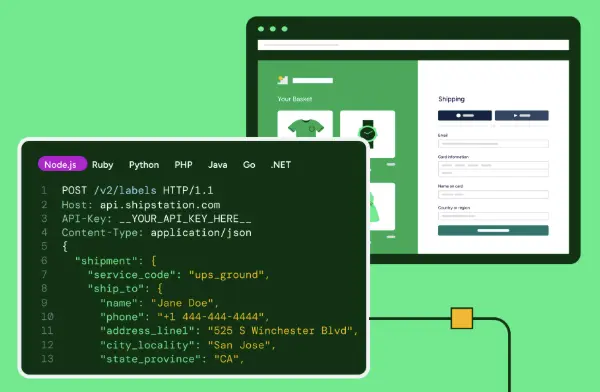
For businesses using shipping software APIs, analytics platforms can monitor API health to ensure reliability and prevent downtime and technical disruptions. Tracking API call volumes, response times, and error rates over time lets you identify degrading performance and uncover optimization opportunities for high-volume API users making millions of calls monthly.
At enterprise volumes, saving even a small percentage on each shipment adds up to significant annual savings. Shipping software attacks costs from multiple angles, creating compounding savings.
The most direct and immediate savings come from access to pre-negotiated carrier discounts and rate shopping capabilities across UPS, USPS, FedEx, DHL Express, and other major carriers.
Rate shopping helps you stay ahead of frequent rate and service changes by managing dynamic rates at scale. More importantly, it optimizes costs by comparing carrier options in real time and automatically selecting the shipping service that meets your requirements, balancing speed, cost, and reliability to get the best rates every time.
Savings aren’t always obvious and are often overlooked. Poor inventory visibility leads to overselling and the cost of carrying excess stock, while shipping errors incur hidden costs that include reshipping expenses, customer service time, and potential customer attrition. These are more reasons why automated verification, address validation, systematic workflows, and real-time inventory synchronization are so crucial.
International expansion represents both a tremendous opportunity and significant complexity. It involves navigating customs regulations, preparing specialized documentation, managing carrier relationships across multiple countries, and ensuring compliance with varied international requirements.
Enterprise shipping technology lets you ship internationally with confidence by transforming international fulfillment from a daunting challenge into a manageable, systematic process. Platforms can streamline cross-border shipping, removing barriers that have traditionally prevented companies from reaching customers worldwide.
The most significant barrier to international shipping is customs documentation. Manually creating forms for thousands of global shipments is impossibly time-consuming and error-prone.
Automated customs documentation eliminates the complications by pulling item information from your product database and account settings, then generating complete customs documentation.
This automation isn’t just faster—it’s more accurate and consistent. When you define customs information once in your product records, that data automatically populates every international shipment containing those items.
High-powered shipping platforms also electronically submit customs information directly to carriers’ systems, accelerating customs clearance, reducing risk, and eliminating the manual step of printing and attaching forms to packages.
Beyond generating customs documentation, an enterprise-grade platform helps you navigate and adapt to compliance and regulatory requirements and manage duties and taxes.
Different carriers excel in different regions and service levels. Shipping software that integrates with multiple international carriers enables enterprises to optimize carrier selection by destination, service level, and cost without managing separate systems for each carrier.
The best shipping platforms integrate with major international carriers and regional carriers across the United States, Canada, Australia, New Zealand, United Kingdom, and other parts of Europe, so businesses can leverage the strengths of different carriers for different international markets through a single platform.
There’s no need to learn different processes for different carriers. The software automatically adapts to each carrier’s requirements.
The cumulative effect of these capabilities means companies can expand into new international markets knowing their shipping infrastructure handles customs documentation, carrier integration, and compliance requirements automatically. What once required specialized expertise and significant manual labor becomes a smooth process with minimal additional overhead.
Fast-growing brands should also pay attention. Navigating the transition from mid-volume to high-volume shipping requires investing today in handling tomorrow’s volume. Implementing enterprise-ready capabilities now builds the foundation your business needs to scale with revenue. Otherwise, you risk outgrowing your shipping solution.
What starts as a simple task, like printing labels and dropping off packages, can quickly turn into a daily strain as order volume climbs. That’s why investing early in powerful shipping software is a smart move, not a luxury. Strong systems established early tend to last.
Growth is exciting—but only when your operations can keep pace with increased demand.
High-volume and enterprise-level shippers need to move fast, automate everything, and integrate their complex systems without slowing down. The right platform empowers brands to fulfill more orders faster, maintain accuracy, and reduce expenses.
At its core, it consolidates order management, label creation, carrier selection, inventory tracking, warehouse management, customer communication, and other shipping capabilities into a single platform that optimizes enterprise operations.
Sign up for a free trial of ShipStation to get these capabilities and other functionalities that transform your existing—or future—high-volume shipping operations.