Back
Back











































 Carriers & Rates


DHL shipping rates reflect the carrier’s delivery speed, customs expertise, and global reliability—qualities that reduce operational risk in international shipping and fulfillment. Businesses that consider DHL too expensive often focus solely on shipping costs and underestimate the downstream costs of delays, customs failures, inventory disruptions, and customer dissatisfaction.
When predictability protects revenue, brand trust, and cash flow, DHL becomes less a premium carrier and more a form of risk insurance for ecommerce and other businesses that ship across borders.
DHL is not designed to be the lowest-cost option. It’s designed to absorb complexity and mitigate the operational and financial risks associated with international shipping.
This guide explores how DHL shipping rates work, when DHL should be used, and how shipping software like ShipStation helps businesses integrate DHL into a broader, multi-carrier shipping strategy to simplify fulfillment, cut costs, and automate processes within a single platform.
Domestic shipping rewards efficiency and scale. International shipping rewards control and predictability.
The moment a package crosses a border, uncertainty increases as businesses try to navigate the complexity of international shipping. Customs inspections vary by country and the type of product. Documentation errors can delay or block delivery. Local delivery networks introduce handoffs that reduce visibility. Customer expectations rise while tolerance for delays drops.
Each of these variables creates risk. That risk manifests later as customer complaints, refunds and exchanges, chargebacks, and operational strain from managing returns. DHL’s pricing reflects the cost of managing these variables on behalf of the shipper. Faster transit times, in-house customs expertise, and a tightly controlled global network all reduce the probability of disruption.
When evaluated shipment by shipment, DHL rates may look high. When assessed across the full lifecycle of an international order, DHL business shipping rates look competitive.
DHL international delivery costs are not simply transportation fees. They are a bundled price for speed, reliability, and complexity management.
DHL shipping cost factors include:
Dimensional weight pricing is enforced strictly. Surcharges are applied transparently. Routes with higher complexity cost more.
When delivery time is top priority, many businesses opt for DHL Express shipping. DHL Express is more expensive than standard options, but speed, predictability, and reduced risk often justify the DHL Express price rate.
Using ShipStation’s shipping rates calculator is the best way to get fast, accurate pricing from top carriers and compare carrier service level costs, such as standard DHL shipping rates and the additional cost of DHL Express.
Unlike some carriers that inconsistently enforce dimensional rules, DHL applies them universally. DHL pricing by weight is strictly enforced. The carrier’s network is predominantly air-based, where space is finite and expensive. A lightweight but bulky package consumes the same aircraft capacity as a heavy one, which is reflected in the shipping rates.
This pricing structure provides leadership teams with greater clarity and helps businesses cut costs. Companies that invest in packaging design optimization often find that DHL rates become far more predictable over time.
Speed in international shipping is often seen as a customer experience feature, but it’s also a financial lever.
Faster delivery shortens cash conversion cycles. Inventory in transit represents capital that cannot be reinvested. DHL’s transit times reduce the gap between shipment and revenue recognition. For high-value or fast-moving products, this effect can offset higher shipping costs.
Speed also reduces operational strain. Slow international shipping generates customer inquiries and escalations. Each “Where is my order?” ticket consumes time and erodes trust. DHL’s reliability lowers support volume, protects brand credibility, and builds customer loyalty that drives repeat purchases.
Surcharges indicate where complexity exists. Certain destinations consistently incur higher fees. Specific product categories trigger additional handling, and poor packaging design results in higher dimensional penalties.
Businesses that analyze surcharge data and other shipping analytics can make informed decisions about where to ship, which products to offer internationally, and when premium shipping should be required or priced accordingly.
The mistake is absorbing surcharges passively instead of learning from them. This is where shipping software becomes critical.
DHL excels in specific scenarios: time-sensitive international deliveries, high-value goods, and complex customs environments. It is often the ideal choice when delivery failure is expensive. Meanwhile, postal or ground-based carriers may offer a better cost-to-service ratio for low-margin, lightweight parcels and non-urgent shipments.
No single carrier is optimal for every shipment. With a multi-carrier shipping strategy, you can leverage the distinct strengths of each carrier and select the best option for each shipment.
The strategic edge comes from having the carrier flexibility to choose the right provider every time. With a network of carriers that includes UPS, USPS, FedEx, DHL, Royal Mail, and other major carriers, ShipStation provides the flexibility needed, while centralizing carrier access, automating decisions, and scaling with growing businesses. DHL is just one option within a broad range of carrier choices.
By integrating DHL alongside other carriers, ShipStation allows businesses to compare rates, delivery times, and service levels in a single interface.
Most DHL “problems” are not carrier failures. They are usage failures. Common issues arise when businesses use DHL reactively to recover late orders, apply DHL without packaging controls, absorb rising surcharges without analysis, and lack clear policies to determine if and when DHL should be used. Each of these reflects tactical decision-making rather than strategy.
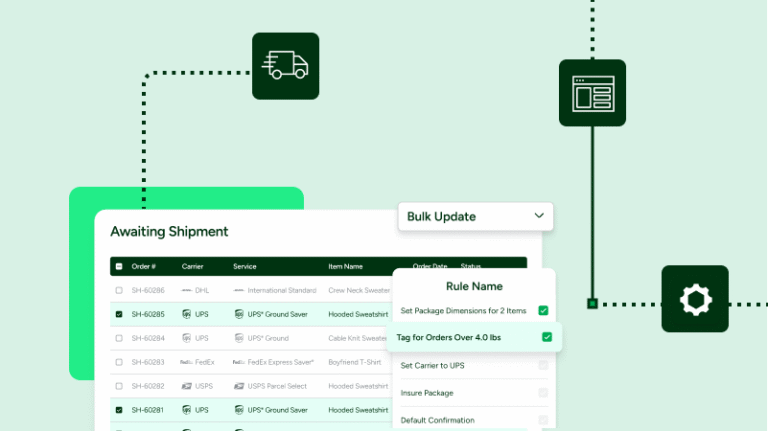
ShipStation helps prevent these problems by making carrier selection a deliberate process. Rules-based shipping automation allows teams to define when DHL is the optimal option, and visibility into rates and delivery times reinforces those rules in day-to-day operations.
International shipping significantly influences brand perception, particularly in markets where customers have limited or no prior experience with the business. The goal is not to ship everything with DHL. The goal is to utilize DHL when failure is costly, speed is crucial, and predictability safeguards value. Regardless of the use case, ShipStation’s shipping platform helps align carrier choice with brand promises that foster trust through fast and reliable delivery.
In global commerce, the companies that win are not those that ship the cheapest. They are the ones that ship deliberately. Sign up for a free trial of ShipStation to ship smarter and expand your global reach with DHL and other top carriers.